

When we talk about sharks, it's quite difficult not to compare the different species. In this case, we're going to evaluate and compare the different sizes of sharks to determine which is the largest shark in the world. Sharks are cartilaginous fish belonging to the family Chondrichthyes. There are more than 360 known species, and they have been found on our planet since prehistoric times.
In this article we're going to compare some of the best-known shark species to find out which is the biggest shark in the world.
The largest shark in the world
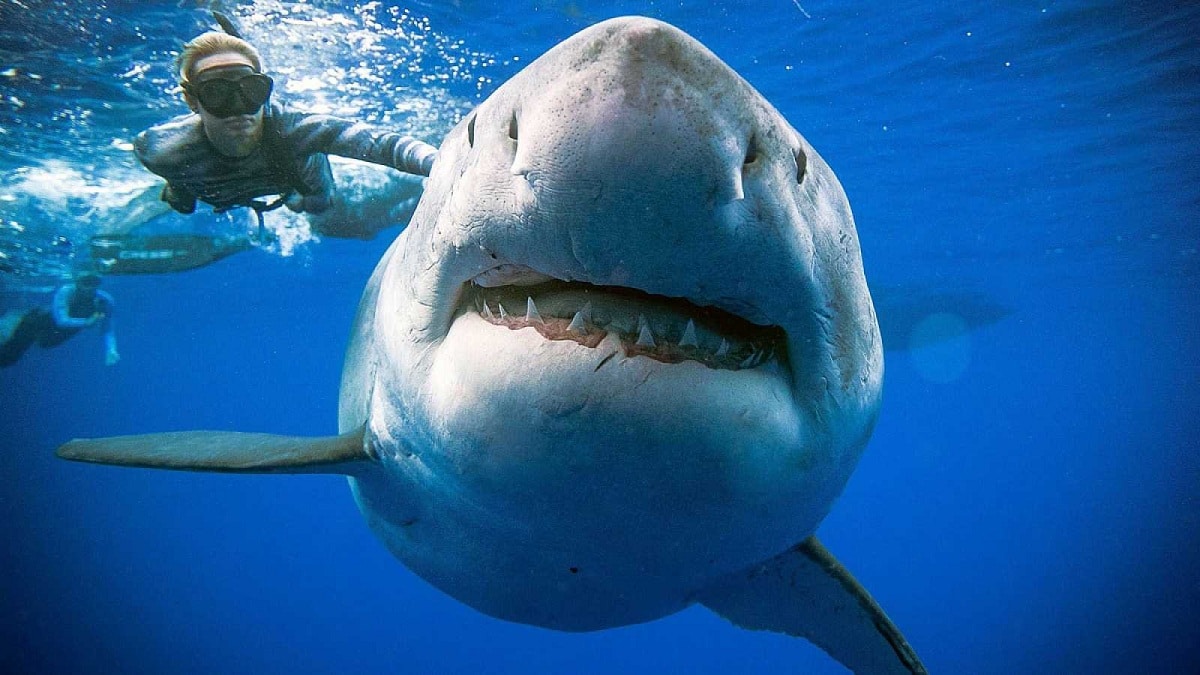
Determining the largest shark in the world is quite complex due to the enormous diversity of species and the fact that they have been known for hundreds of millions of years. The image of a shark is easily recognizable worldwide, whether from aquariums, television reports, documentaries, or movies.
Sharks are often portrayed as the typical animal that intends to attack humans . They are a group of predators with an incredible capacity for adaptation. However, sharks are much more than that. They are some of the largest and most fascinating animals in our oceans and seas.
Given that there are various schools of thought and opinions about which is the largest shark in the world, we will first make a top 3 list of the largest sharks currently in existence and then explain the case of the megalodon , the extinct giant.
Great white shark

The great white shark is one of the most well-known sharks in the world. It is one of the largest and most powerful predators in existence. It can reach a weight of around 1.115 kilograms in its prime. Its distribution area extends throughout all the world's oceans, with particular abundance in the temperate coastal waters of North America, southern Africa, and southern and western Australia.
The great white shark possesses extremely sharp , triangular teeth with serrated edges, designed to slice through large chunks of meat. It is undoubtedly the most feared animal in the ocean and the most dangerous in the event of an attack due to the devastating effect of its bite; even so, it rarely attacks humans . It often mistakes swimmers or surfers for seals or other natural prey, or will only attack if it feels threatened. Once it recognizes that we are not its prey, it loses interest, but its first exploratory bite can be very serious.
Females tend to be larger than males , a common sexual dimorphism in sharks. The "man-eating" reputation is neither fair nor representative. In fact, other marine animals cause more incidents involving people than the great white, and its ecological role as a population regulator is key to the health of ecosystems.
Basking shark
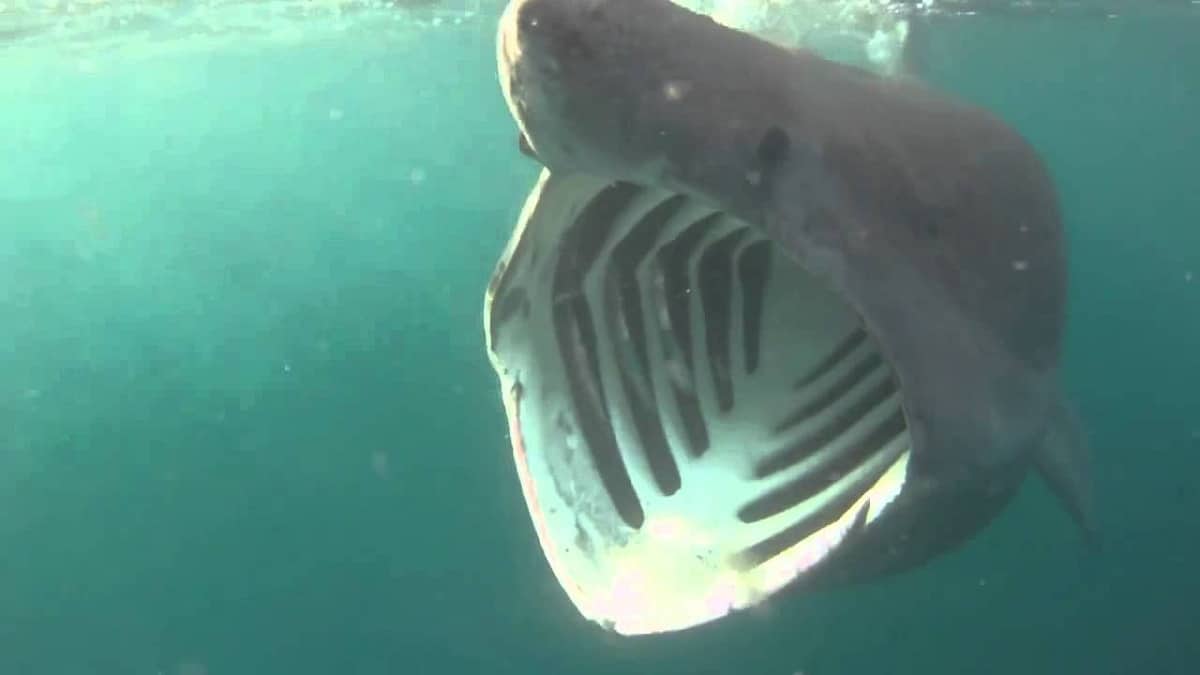
The basking shark can reach up to 10 meters in length and weigh around 4 tons, making it the second largest shark species in the world. Its main characteristic is that it swims with its mouth open to filter water and collect plankton.
One of its primary food sources is zooplankton . Thanks to its filter-feeding apparatus, it can filter thousands of tons of water per hour while moving slowly. Its reproduction is ovoviviparous: the eggs hatch inside the mother and the pups are born live, a common reproductive method among large sharks.
Despite its disproportionately large mouth, it is completely harmless to humans. It prefers cold and temperate waters near the surface and is widely distributed in latitudes far from the equator, in seas and oceans all over the planet.
Whale shark

The whale shark , as its name suggests, is the largest fish in the world . It could be said that, among living sharks, it is the largest in existence. It is a shark that can exceed 30 tons in weight and reach lengths of nearly 20 meters in exceptional specimens. It feeds on plankton , tiny algae, small fish, and crustaceans, and roams almost all the world's oceans.
It is a peaceful and docile shark, despite its imposing size. When it opens its mouth, it swallows large volumes of water to pump it through its gills, where fine structures called dermal denticles act as a filter and trap almost any creature larger than a few millimeters.

This specimen could be called the king of kings among modern sharks. It is as spectacular as it is harmless, posing no threat to humans or most other ocean species. They are most frequently seen near the equator , where warm waters favor an abundance of plankton.

How do we define "bigger" and how is it measured in sharks?

When we talk about "bigger," we can refer to length , mass , or even mouth span . Among living sharks, the whale shark holds the record. The basking shark follows in length, although it is less massive. The great white shark, despite its fame, doesn't rank among the largest living sharks, although it is among the apex predators in terms of power and hunting strategy.
For extinct sharks, such as the megalodon, scientists must estimate their size from partial remains , primarily teeth and some vertebrae, since the cartilaginous skeleton fossilizes poorly. Comparative models with extant species, allometric relationships between tooth size and total length, and methods relating root width or crown height to body size are used. Despite the different methodologies, there is broad consensus: the megalodon was the largest shark in history.
Megalodon: the largest shark that ever existed (extinct)

The megalodon (commonly referred to as Carcharocles megalodon or Otodus megalodon ) was a marine apex predator and the largest shark ever recorded . The most widely accepted estimates place its maximum length at over 16 meters , and in exceptional cases even greater, with masses of tens of tons . Its bite , thanks to colossal jaws and triangular, serrated teeth up to more than 18 cm tall, would have exerted forces far greater than those of any modern shark, capable of fracturing the bones of large cetaceans.
Its robust teeth , with finely serrated edges and well-developed roots, were perfect for cutting and holding powerful prey. The fossil record indicates a cosmopolitan distribution , with a presence in temperate and subtropical latitudes and possible breeding areas in warm coastal waters . Like other sharks, it would have been ovoviviparous ; the pups were born live and, according to the evidence, emerged large at birth , which reduced their vulnerability.
Its diet included marine mammals (from dolphins to large whales), turtles , and other fish. Different lines of geochemical and morphological evidence suggest that it was a top predator at a very high trophic level . Furthermore, as is the case with large modern sharks, it would have possessed some form of regional endothermy , allowing it to maintain higher internal temperatures and hunt in relatively cold waters with great swimming efficiency.
There is scientific debate about its taxonomic position : some studies group it in the genus Carcharocles , while others place it in Otodus within the extinct family Otodontidae . What is widely accepted, however, is that it is not a direct ancestor of the great white shark , but rather a related lineage of large "megatooth sharks" that evolved in parallel, with similar teeth due to convergent evolution.
Why did it become extinct? Its disappearance is attributed to a combination of oceanographic changes that reduced warm breeding habitats, variations in prey availability (especially baleen whales), and competition with other large predators such as the ancestors of killer whales and the modern great white shark. Relying on high energy demands , a decrease in available food may have made its lifestyle unsustainable.

It is important to emphasize that there is no scientific evidence to support the current presence of living megalodons. Fossil remains and the absence of recent sightings in the areas where they should be found clearly point to their extinction . Popular fascination has fueled myths, but the expert consensus is solid: the largest shark in history no longer inhabits our oceans.
Other current giant sharks (beyond the “top 3”)

- Greenland shark (Somniosus microcephalus): can exceed 6-7 metersIt is one of the extremely slow-growing longest-lived vertebrates acquaintances. Lives deep Arctic waters And its vision is very limited. Its biology makes it especially vulnerable to human impacts.
- Great Hammerhead Shark (Sphyrna mokarran): reaches 4-6 meters. On T-head It gives a very wide stereoscopic view. It's in critical danger by targeted and accidental fishing.
- Tiger shark (Galeocerdo cuvier): exceeds the 5 meters in females. It is a apex predator opportunistic, with a broad diet and great ecological importance.
- Megamouth shark (Megachasma pelagios): rare and oceanic filter feeder, it hovers around 5 metersIts discovery is relatively recent and it remains infrequent in sightings.
- bluntnose sixgill shark (Hexanchus griseus): can approach the 5 metersDeep-water, with six gill slits and generally nocturnal habits.
- Goblin shark (Mitsukurina owstoni): reaches close to 4 meters. The depths and unmistakable appearance with an elongated snout and protrusible jaw.
- Mako shark or shortfin mako (Isurus oxyrinchus)3-4 meters, the Faster among sharks, capable of performing spectacular jumps out of the waterThreatened by overfishing.
- Bull shark (Carcharias taurus): until 3,5 metersRobust appearance and reputation for aggression, although incidents with humans are uncommon.
- Spotted or cow shark (Notorynchus cepedianus): around the 3 meters, one of the few with seven gill slitsPredator of rays, seals and other fish.
- Nurse shark (Ginglymostoma cirratum)2,5-3 meters. Relatively small mouth, feeds by suction of mollusks and crustaceans.
- Blue shark (Prionace glauca)2-3 meters, stylized and large ocean migrantOne of the most common, although with declining populations.
- Angel shark (Squatina squatina): until 2,5 meters, similar in appearance to a stripe. Critically endangered in many areas due to bottom trawling.
Behavior, feeding and reproduction of giant filter feeders

The two largest living sharks, the whale shark and the basking shark , share a filter-feeding strategy . They open their mouths while swimming to channel large volumes of water toward their gills, where specialized structures retain plankton and small organisms. This diet explains their harmless nature and their preference for areas with high productivity, such as upwellings or aggregations of krill and larvae.
Reproduction in several of these giants is ovoviviparous . In the case of the peregrine falcon and other lamniforms, oophagy (consumption of unfertilized eggs by the embryos) has been observed within the uterus, allowing the young to reach large sizes at birth and increasing their chances of survival.
Conservation and safety: what we can do and what we need to know

Many of the largest sharks face serious threats : targeted and incidental overfishing, demand for fins, habitat degradation, and pollution. The whale shark is listed as highly threatened , and the basking shark is a protected species in numerous jurisdictions. Conservation requires effective fisheries regulations , protection of migratory routes and breeding grounds , and a reduction in demand for shark products.
Regarding safety at sea, the general rule is respect and distance . Most sharks do not see humans as prey. Avoiding marine mammal feeding areas at dusk, not carrying caught fish close to your body while diving, and maintaining non-intrusive behavior further reduces an already very low risk. Responsible diving with filter-feeding sharks, conducted by certified operators, can be a safe and transformative experience that also promotes their conservation through ecotourism.
Frequently asked questions about the “biggest shark”
What is the largest living shark? The whale shark, by length and mass. It is a peaceful, cosmopolitan filter feeder found in warm waters.
What was the largest shark in history? The now extinct megalodon far surpassed any modern shark in size and bite power.
Is the great white shark the largest living marine predator? It's one of the largest and most studied apex predators , but there are orcas and other cetaceans that rival or surpass its size. Among predatory sharks, it is indeed one of the largest.
How do scientists estimate the size of extinct sharks? They use teeth and vertebrae , along with statistical relationships validated in current species, to extrapolate length and mass.

Quick guide to identifying large sharks from the article
- Whale shark: pattern of Moles and lines; very wide mouth at the front; filter; tropical.
- Basking shark: huge mouth semicircular; swims with its mouth open; prominent dorsal fin; temperate-cold.
- Great White: conical snout, robust bicolor body (dorsal gray, ventral white), triangular teeth with serration.
- Megalodon (extinct): known for giant teeth triangular; there are no valid contemporary sightings.
With all of the above in mind, we can say that the question of "the world's largest shark" has two complementary answers: the whale shark is the giant among living sharks , and the megalodon was the colossus among the extinct ones . Knowing their characteristics, understanding how their sizes are estimated, and demystifying their behavior helps us to appreciate and protect them better. I hope this information helps you learn more about the world's largest shark.

Table of Contents
- 1 The largest shark in the world
- 2 How do we define "bigger" and how is it measured in sharks?
- 3 Megalodon: the largest shark that ever existed (extinct)
- 4 Other current giant sharks (beyond the “top 3”)
- 5 Behavior, feeding and reproduction of giant filter feeders
- 6 Conservation and safety: what we can do and what we need to know
- 7 Frequently asked questions about the “biggest shark”
- 8 Quick guide to identifying large sharks from the article