
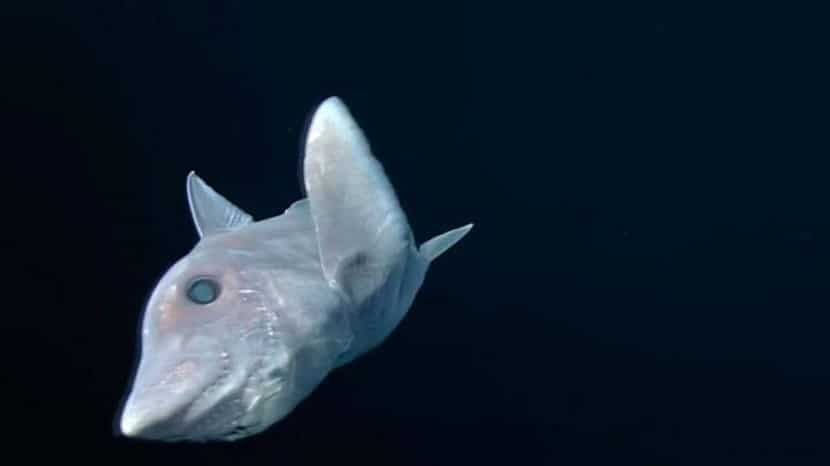
One of the most curious and mysterious sharks that exist throughout the seas is the ghost shark, One most curious fishIt is one of the species de peces cartilaginous bones are more slippery, so It's very difficult to observe. and to learn about its biology in detail. It is a group from which we are still learning continuously thanks to recordings, findings in research campaigns, and specimens that wash up dead on the coast.
In this article we will tell you everything you need to know about the ghost shark and what is known about its behavior and habits, integrating new key data on its morphology , habitat , diet , reproduction and conservation status.
Key features

It is a group de peces which, although often called sharks, are better known by the name of chimeras. belong to the family Chimaeridae (among other families of the same order) and to the gender Hydrolagus in several of its species; the order is Chimaeriformes, the only living representative of the subclass HolocephaliInstead of a single “shark”, today we recognize dozens of species of chimeras, all with common features and surprising particularities.
Their appearance is truly striking: their heads display lines and reliefs reminiscent of sutured plates , giving them an ancient look. Their large, peculiarly colored eyes appear "glassy," an adaptation to the scarcity of light in the deep sea. Unlike other sharks, they don't have replaceable, sharp teeth; instead, they possess dental plates that act like mills to crush tough prey.
The original text stated that “it does not have large, fearsome-looking teeth; instead of teeth, it has bony plates with which it grinds its food.” This point is key: dental plates are permanent and very resistant, ideal for crustaceans and mollusks.
The appearance of this species, which has existed for hundreds of millions of years , is so unique that they are often called ratfish or rabbitfish , considered among the rarest fish in the world due to the shape of their mouth and tail. One of their most distinctive features is the intense bluish-gray or whitish color in some specimens, which contributes to the nickname "ghost." Their snout is pointed, and in males, a retractable reproductive organ on the head (cephalic tentacle) is prominent, in addition to the claspers or pterygopods used for copulation.
Another important difference from "classic" sharks is that chimeras have an operculum covering their gills, so only one gill opening is visible on each side. They are also easily recognizable by the venomous spine in front of the first dorsal fin, used for defense, and by their gliding motion, achieved by powerful undulations of their pectoral fins.
- Cartilaginous skeleton and jaw fused to the skull (holocephaly).
- Dental plates permanent for crushing hard prey.
- Venomous spine on the first fin for defense.
- Branchial operculum and a single opening per side.
- Locomotion with undulation of pectoral fins.
- Colorations variables: brown, gray, whitish or bluish.
- Size average around 1 m, with species ranging from a few decimeters to nearly 2 m.
Among the best-known species are Hydrolagus trolli (the pointy-snouted ghost shark), Hydrolagus melanophasma , Hydrolagus matallanasi , and chimeras from other families such as Callorhinchus milii in the Southern Hemisphere. Each occupies a deep niche and exhibits variations in color, size, and snout shape.

Range and habitat
The ghost shark has a very wide distribution . It is found in the Indian, Pacific, and Atlantic Oceans , thriving in temperate waters and, depending on the species, also in tropical regions. Its typical habitat is on the seabed (benthic habits), on slopes and mid-ocean ridges, where light is almost nonexistent.
They typically develop and inhabit depths ranging from several hundred meters to over two thousand meters . Although their most frequent range is around the bathyal zone, sightings have been documented in shallower waters than usual, which has facilitated some recent observations and filming using remotely operated vehicles (ROVs).
The original article mentions that their natural range is located around the Tasman Sea and that they are most abundant between the southeastern and central Pacific. Indeed, several species are concentrated in that region, but there are other notable distributions: for example, the Chatham Rise , east of New Zealand, has been an area of significant discoveries, and records have also been reported off California and Hawaii for species such as Hydrolagus trolli.
Their behavior is elusive , and the conditions of the deep sea make them difficult to track. They are agile fish that alternate between slow movements and bursts of speed and sudden changes of direction when they detect prey or potential threats.

Ghost shark feeding
This species of shark (chimaera) is primarily carnivorous . While its exact diet is not fully understood for all species, it is generally agreed that it consumes benthic invertebrates (such as mollusks and crustaceans) and small fish . The morphology of its mouth, located on the underside and equipped with dental plates, is consistent with a strategy of crushing shells and carapaces.
A striking physiological feature is their simple digestive system : several species lack a differentiated stomach, so food passes directly into the intestine. This allows for continuous and efficient digestion of both hard and soft foods.
Investigating their diet is complex due to the depth at which they live and their mobility. Even so, stomach content analysis and direct observation with ROVs point to prey such as decapod crustaceans , bivalve mollusks and gastropods , polychaetes , and small demersal fish. The powerful jaw musculature and the interlocking of the dental plates explain their efficiency in breaking calcified structures.
The original content already indicated that "their diet consists mainly of crustaceans and small fish," and this idea is reinforced by recent field data: the diet is opportunistic, with a preference for bottom-dwelling prey and with variations according to species and region.

Reproduction of the ghost shark
Regarding their reproduction, these fish are oviparous : they reproduce by laying eggs. Copulation is internal, and the males use claspers (copulatory appendages) and a retractable cephalic tentacle to grasp the female. The females produce leathery egg capsules that are deposited on the bottom, where the embryos complete their development.
Their reproduction begins when they reach sexual maturity . The original text indicated that this stage occurs when they exceed 55 centimeters in length; although it varies between species, the pattern fits: first they grow, then they migrate to shallower waters or areas of suitable substrate for spawning, and finally they release the eggs protected by capsules in the form of a “bag”.
There are few direct records of mating in the wild, so much of what we know comes from isolated observations and the study of eggs and embryos. Some species exhibit egg-laying seasons , while in others oviposition may be more spread out. Their lifespan is estimated, in several chimeras, to range from just over a decade to nearly two, with interspecific variability.

One anatomical detail that arouses much curiosity is that, in certain species, the male possesses a retractable appendage on its forehead whose precise function is still being studied. This feature, along with claspers and other prepelvic appendages, constitutes a unique reproductive arsenal in cartilaginous fish.

Threats and conservation
Currently, many chimera species are listed as least concern in conservation assessments, but this does not mean they are not at risk. They are often affected by bycatch in bottom fishing gear, especially nets and longlines, and by uncontrolled trawling in some regions.
Its consumption has been documented in areas of the Southern Hemisphere; for example, Callorhinchus milii in Australia and New Zealand, where it is sold as a substitute for other fish. There are also reports of its capture in recreational fishing, although it is not usually a target species. In global lists, several chimeras still lack sufficient data , reflecting how difficult it is to monitor them.
A particular case is Hydrolagus matallanasi , considered to be in a more precarious situation due to fishing pressure in part of its range. The lack of scientific visibility for deep-sea species necessitates precautionary management and the strengthening of observation programs.
Study difficulty and outstanding findings
This species inhabits extreme depths , often around 2 kilometers below the surface, and the speed at which they move makes sustained observation difficult. Therefore, the study has relied on expeditions with unmanned vehicles and serendipitous discoveries.
A particularly interesting milestone was the video recording of a ghost shark by an ROV in the northeastern Pacific, off the coast of California and Hawaii , in an area where this specific species (previously associated with other latitudes) was not expected. The identification pointed to Hydrolagus trolli , a pointed shark with a jaw fused to its skull and robust dental plates . These types of records expand the distribution map and remind us that many chimeras have a wider range than previously thought.
Similarly, genetic and morphological differences have been described that distinguish populations previously considered a single species. In the Chatham Rise region (east of New Zealand), oceanographic research has identified new chimeras and better defined the presence of narrow-snouted forms in Australian and New Zealand waters . These advances underscore how little we still know about life in the deep ocean.
The operational conclusion is clear: as equipment improves and sampling effort increases, sightings at unusual depths and taxonomic revisions multiply. This has allowed for the description of species that did not fit with those known in the North Pacific and has led to hypotheses of wider distributions than previously thought.
Commercial use and prestige of the ghost shark
These fish are used commercially in regions of southern Australia and New Zealand, although they are generally not the primary target: they are usually caught as bycatch in fisheries such as cod fisheries. Some chimeras are caught off the coast of New Zealand, mainly for nearby markets.
The sociocultural value is interesting: a tribe known as the Ngai Tahu Maori has traditionally considered certain chimeras a prestige food. During the summer, they are caught, dried , and preserved in seaweed bags—an example of local and seasonal use linked to culture and availability.
As you can see, the sea is home to species that seem almost mythical. I hope this information helps you learn more about the ghost shark. Thanks to their evolutionary antiquity, unique anatomical features , and life in the realm of darkness, chimeras continue to be the subject of discoveries that change what we know about the deep ocean. The more we study them, the more evident the need becomes to protect their habitats and support the research that allows us to understand them without disturbing them.
