

You might have an aquarium and want to keep it as clean and healthy as possible so your fish can live in optimal conditions. To do this, you'll need certain items and equipment to improve its maintenance. These include a fish feeder, water oxygenators, and, most importantly, external aquarium filters , the true heart of the filtration system.
A well-chosen external filter helps keep the water crystal clear, free of toxins, and well-oxygenated, resulting in healthier fish, more vigorous plants, and less maintenance for you. It also allows you to enjoy a more aesthetically pleasing aquarium, without bulky equipment inside the tank, and with more even water circulation.
Do you want to know which are the best external aquarium filters, how they actually work, and what you should keep in mind When choosing them according to your type of assembly, number de peces And what about the size of the aquarium? Keep reading, because this is your post
The best external filters for aquariums

Before delving into filtration theory and how to choose the perfect filter, it's helpful to know some benchmark models that stand out for their excellent value, ease of use, and proven performance in home aquariums. Below, you'll find the original selection, very useful as a starting point, with comments and nuances to help you understand which filter is best suited for your needs.
External filter for aquarium white and blue

This type of filter is quite good and versatile. It can filter aquarium water up to 400 liters and is suitable for both freshwater and marine aquariums . Assembly is fairly simple and includes three separate compartments for mechanical, biological, and chemical filter media.
Furthermore, the filter operates in stages . This means you can adjust its performance according to the aquarium's biological load and the water's dirt level. It doesn't always run at the same intensity, which is very useful for saving energy, since when water filtration isn't as necessary, it doesn't need to operate at full power. This adjustable capacity makes it ideal for aquariums with varying filtration demands over time, for example, planted aquariums that start with a few fish and gradually become more populated.
It's a suitable model if you're looking for a versatile and relatively quiet filter , with good capacity for adding biological rings and activated carbon, and if you don't want to get bogged down with advanced configurations.
You can use that filter.
Black and red color filter
No products found.
This filter has some really nice red and black accents. The largest part of the filter is transparent, allowing you to see the condition of the filter media without fully opening it, which is helpful for deciding when maintenance is needed.
Its technology ensures enhanced safety by preventing any aquarium overflow, thanks to a highly reliable locking and sealing system . The filter base is made of rubber and operates quietly, making it suitable for living rooms or bedrooms where noise might be a concern.
It filters the water quite well and leaves it clean, making it an interesting option for medium-sized aquariums with heavy load de peces moderateIt is recommended for beginners who want a robust filter without too many complicated setup requirements.
You can buy it.
Professional filter

This more professional type of filter is placed on the edge of the aquarium and has a backpack-style design. It's a good option for small to medium-sized aquariums where space under the cabinet is undesirable or unavailable. It features a fairly quiet pump that draws water from the aquarium and sends it to the reservoir where it is filtered and purified before being returned as a gentle waterfall.
Its efficient filtration technology will help keep the water clean for longer, and its backpack design makes it a great alternative when you need easy access to filter media without having to bend down or dismantle furniture. It's especially recommended for beginner aquariums, shrimp tanks, and tanks with small fish like guppies or killifish.
Its price is very affordable.
External cascade filter

This filter has a very efficient design. It's perfect for adding as decoration without taking up much space inside the aquarium. If you don't have a large aquarium, this type of filter is ideal, as it offers good mechanical and biological filtration with low energy consumption.
It makes very little noise and is suitable for aquariums de peces as well as turtles, which also tend to get quite dirty from using it. The cascading outlet also helps to oxygenate the water, something interesting in aquariums with little surface area in contact with the air.
.
External filter for aquariums with 3 sponges

This is an aquarium filter for aquariums with a capacity of no more than 120 liters . Its operation is quite efficient thanks to its three sponges, which handle mechanical filtration and provide a large surface area for beneficial bacteria to colonize.
It allows you to regulate the water flow with a multifunction valve, which is very useful if you want to adjust the flow for fish that don't tolerate strong currents or for shrimp. It's quite quiet and suitable for both freshwater and saltwater, as long as you respect the maximum recommended volume and maintain it properly.
Buy this filter.
External backpack filter

This type of filter also comes in a backpack style. It's ideal for small aquariums without taking up too much space, especially in small tanks where every inch counts. It's small in size, but its efficiency is comparable to many larger filters, always within the volume limits for which it was designed.
It allows you to filter the water easily, keeping your fish and plants healthy for as long as possible. It's ideal for small planted aquariums where aesthetics are important, as it leaves the aquarium interior free of bulky equipment.
It is quite affordable in value for money. You can see it
Filter with 55W motor

These filters have a 55W motor that operates in an environmentally friendly way, considering the large volume of water they can move. This filter is necessary if you want to purify the water in large tanks up to 2000 liters, such as ponds or very large aquariums with large fish.
It also features a 9W clarifier and a pre-filter that helps remove larger debris, preventing the main filter from deteriorating. This mechanical pre-filtration extends the lifespan of the sponges and biological media, reducing the frequency of maintenance.
You can see its price.
What to consider when choosing an external filter for aquariums
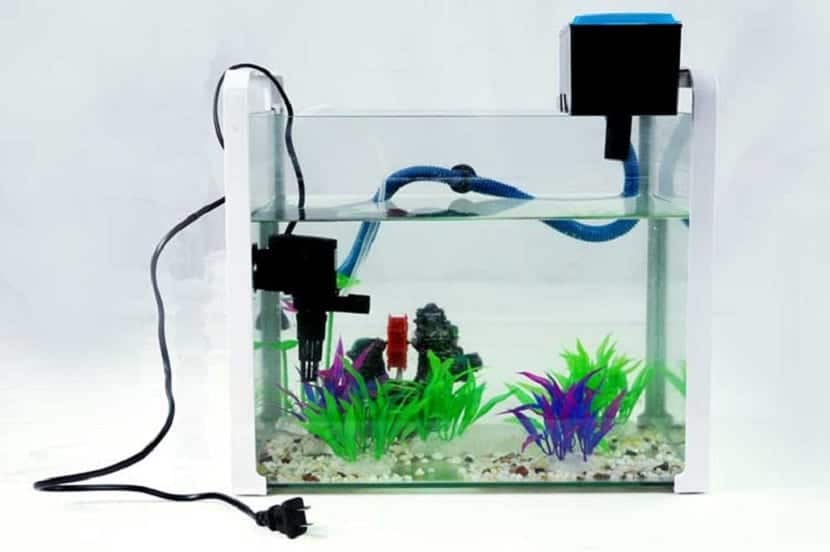
As we've discussed in other articles, a water filter is a very important element for providing the best conditions for your fish. Keeping the water clean and oxygenated is essential if we want our fish to grow well and live long lives. Furthermore, this means we won't have to change the aquarium water as often, saving time and minimizing disruption to the tank's ecosystem.
Currently, we find a large number of external filters for aquariums of all types. This makes choosing the right one a challenge . To select the filter that best suits our needs, we must consider some basic aspects and other more advanced ones that are often overlooked.
The first step is to know the exact size of the aquarium to determine the volume of water that needs to be filtered to keep it clean. Filtering the water in a 50-liter aquarium is not the same as filtering a 300-liter aquarium, and a tank with few fish is not the same as one with a large population or predators. The actual water volume (taking into account substrate, driftwood, and decorations) is usually slightly less than the tank's gross volume, but when choosing a filter, the nominal volume is typically used, with a safety margin added.
External filters are generally the best option for medium and large aquariums, and also for many small aquariums when maximum biological stability is desired . If internal filters are used and space for the fish is limited, they will hinder the fish's freedom of movement and detract from the aesthetics of the aquascape. Therefore, it is much better to place them externally so they can perform their function more efficiently.
The second aspect to consider is the budget . Just as there are many different ranges, there are also many different prices. It's best to review the various features the filter offers so you can choose the one that best suits your needs. Sometimes it's more cost-effective to invest a little more initially in a filter with a larger volume of filter media and better efficiency than to buy a basic model that will force you to add another filter later.
Besides the size of the aquarium and the budget, there are other factors worth considering:
- Aquarium typeA demanding planted aquarium is not the same as a cichlid aquarium, a goldfish tank, a shrimp tank, or a breeding tank. Each setup has different filtration requirements.
- Biological load: the number de pecesTheir size, feeding frequency, and the presence of invertebrates determine how much organic matter is generated daily.
- Aquarium locationIf it's in a bedroom or rest area, the noise level of the filter becomes a key factor.
- AccessibilityYou should be able to easily access the filter to perform regular cleanings without having to dismantle half the living room each time.

How to calculate the flow rate and filtration capacity you need
One of the most common mistakes when choosing an external filter is relying solely on the theoretical flow rate figure printed on the manufacturer's box. This figure usually indicates the pump's maximum power under no load, meaning it doesn't take into account the water's height, hose bends, or the resistance offered by the filter media as it gets dirty.
To really get it right, you need to consider two key aspects: the filtration demand of your aquarium and the actual effective flow rate of the filter.
Filtration requirements according to aquarium type
We can classify aquariums into three groups according to their filtration requirements:
- High filtration demandAquariums with a large number de pecesAquariums with cichlids, goldfish, demanding planted aquariums (aquascaping), or heavily fed tanks. In these cases, the filter must be able to process between 4 to 5 times the volume of the aquarium per hourFor example, a 100-liter aquarium needs a filter with an actual flow rate of 400-500 l/h.
- Moderate filtration demandCommunity aquariums with small to medium-sized fish, a balanced population, and moderately maintained plants. Recommended here are between 2 to 3 times the volume of the aquarium per hour.
- Low filtration demandAquariums with very few fish, sparsely populated shrimp tanks, or special low-energy setups. They can function with 1-2 times the volume of the aquarium per hour or even less, provided that regular water changes are carried out.
As a practical reference, in most community-type domestic aquariums, it usually works very well to choose a filter that, in practice, moves around 3-4 times the volume of the aquarium per hour.
Why you shouldn't trust the manufacturer's theoretical flow rate
Many manufacturers optimistically list the pump's flow rate in liters per hour. But an external filter isn't just a pump: it includes tubing, elbows, filter media baskets, and typically raises the water about 80-100 cm from the cabinet to the aquarium. All of this significantly reduces the actual flow rate.
Furthermore, over time, the filter becomes partially clogged with dirt, further reducing the actual flow rate per hour. Therefore, the best way to assess real-world performance is to look for independent tests or video reviews that measure the effective flow rate, or to apply a simple rule of thumb.
If you don't have that information, a reasonable approximation is to divide the flow rate indicated by the manufacturer by two . For example, if a filter claims a flow rate of 1000 liters per hour, its actual filtration capacity, with the materials and in use, will be about 500 liters per hour.
With this information, you can return to your aquarium volume and check if the chosen filter meets the minimum number of revolutions per hour you need according to the biological load of your tank.
Example of a practical calculation
Imagine an average aquarium of 100 liters :
- If you have one high bioburden For a demanding aquascape, the actual filter flow rate should be 400-500 liters per hour. This means the filter's declared capacity should be around 800-1000 l/h.
- For a moderately populated aquarium, which requires between 2 and 3 volumes per hour, an actual flow rate of 200-300 l/h is sufficient, which would lead us to choose a filter with a declared flow rate of around 400-600 l/h.
If you choose a filter only because the manufacturer states that it is "suitable up to 300 liters", but your aquarium is heavily populated and the filter has a low actual flow rate , you could be forced to add an extra internal filter or even a second external filter, with the consequent additional cost.

Main features of a good external filter
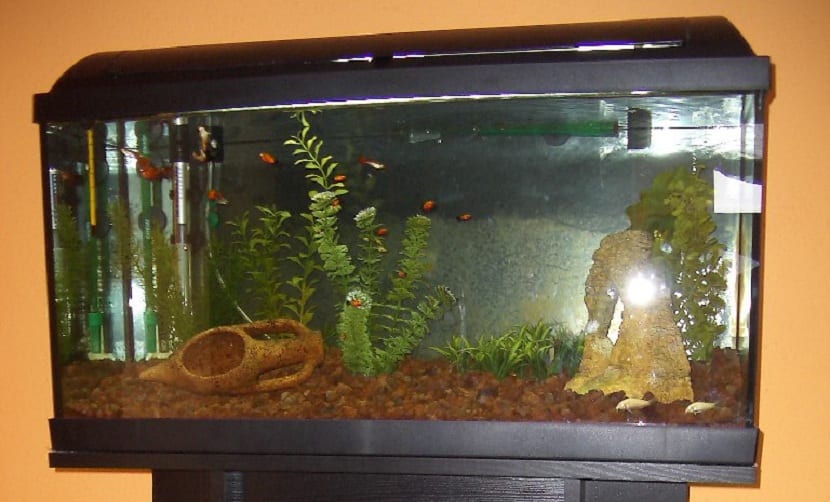
The best way to choose the right filter for your needs is to carefully review its features. It's an essential tool that helps maintain the water quality and remove impurities that accumulate as life develops in the aquarium. These impurities include uneaten food , fish waste, and loose plant leaves. All these particles degrade the aquarium water, making filtration necessary. This also extends the time between water changes.
A good external filter should offer all three types of filtration in a balanced way :
- Mechanical filtrationIt retains suspended solid particles (leaf debris, uneaten food, detritus). This is done using sponges of varying thicknesses, or perlon.
- Biological filtrationIt provides a surface where nitrifying bacteria can colonize and transform toxic substances such as ammonia and nitrites into less dangerous nitrates. This is achieved using ceramic tubes, bio-balls, porous materials, etc.
- Chemical filtration: removes undesirable dissolved compounds (odor, color, drug residues) with materials such as activated carbon, specific resins or peat, depending on the case.
It's important to ensure that the external filter is easily and securely installed . Connections to the outside via hoses and valves are ideal for effortless water circulation and faster cleaning. The higher the filter's flow rate, the more water it can clean per unit of time, but this should always be combined with a generous volume of biological filter media.
The only drawback of external aquarium filters is that they generate some noise during use and take up space outside the aquarium, usually inside the cabinet. They also tend to be the most expensive, although quite competitively priced considering their durability and filtration capacity. To avoid these drawbacks, it's advisable to choose well-known brands that use ceramic shafts, well-balanced rotors, and quality plastics, ensuring smooth and quiet operation.
On the market, we can find very reliable external filters from manufacturers such as Eheim , Fluval, Oase, and JBL, among others. These brands have incorporated improvements such as automatic priming , easily removable independent compartments, and, in some advanced models, even integrated heaters or optional UV modules.

Advantages of external filters compared to other filtration systems
Although sponge filters, internal filters, and hang-on filters are very useful in certain contexts, external (canister) filters offer a number of advantages that make them the preferred option for most medium and large aquariums.
- Larger volume of filter materialSince it's located outside the aquarium, the filter body can be much larger. This allows for the use of more mechanical sponge and, above all, more biological filter media, which translates into... greater stability of the nitrogen cycle.
- cleaner aestheticInside the aquarium, only two small-diameter tubes (inlet and outlet) are visible, which are usually discreet and can be hidden with plants or other decorative elements.
- quiet operationLeading brands have developed motor heads with electromagnetic turbines and ceramic shafts that significantly reduce vibration. Because they are housed within the cabinet, the noise level in the room is very low.
- Great flexibilityThe filter canister usually has several baskets or compartments where you can configure different filtration methods using ceramic rings, bio-balls, sponges, resins, filter floss, etc. This allows you to adapt the filter to the specific needs of your aquarium.
- Low maintenanceBecause they have a large volume of filter material, they saturate more slowly than other systems. Maintenance intervals can be extended. Several months if the aquarium is well balanced.
- High efficiencyThey combine good flow rate, a large volume of biological support, and customization options. For this reason, they are considered one of the safest and most efficient methods for fully enjoying the aquarium and its inhabitants.
How to install an external aquarium filter step by step
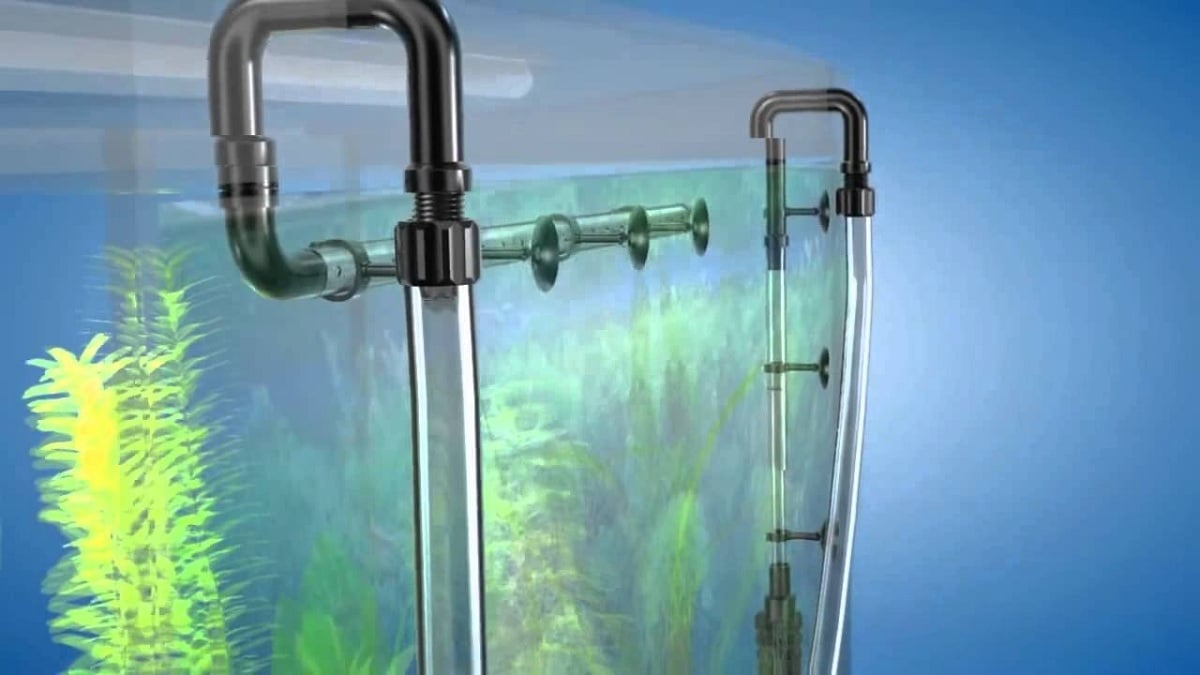
When installing an external aquarium filter, it's normal to have some questions, especially if it's your first time using a canister filter. The main components are: the filter itself, the aquarium filter tubes, the filter media, the external filter priming system, and the hoses.
Let's see how to assemble the aquarium filter step by step with the basic ideas you should always keep in mind:
- The first step is to assemble the aquarium filter hosesTo do this, connect the diffuser bar to the outlet arch. This diffuser bar is responsible for pouring the filtered water into the aquarium. Position it to create a good flow. water circulation and, if you wish, some light movement to improve oxygenation.
- We attached the water intake nozzle to the aquarium using the suction cups. We connected the nozzle to the filter's water inlet, ensuring the connections were secure to prevent air leaks.
- These hoses usually enter the different tubes under pressure. If you want to make them more flexible, You can warm them up a little Use hot water to help them fit better and stay snug without leaks.
- To install the filter media, pay attention to the direction of water flow within the filter. Normally, water enters from the top and exits from the bottom, or vice versa, depending on the model. The filter media should be loaded first. mechanical filter materials (sponges and perlon) to retain large particles, and then the biological filter materials so that the necessary environmental conditions can be created for the nitrifying bacteria colonies to establish themselves.
- Once the mechanical and biological filter materials are in place, we add the chemical filter materials such as activated carbon or specific resins, only when truly necessary (for example, after medical treatment or to remove tannins). It's important to check that all filter materials are efficient and in contact with the filter walls, preventing gaps where water could escape without passing through them.
- Priming the filter is a key step. Some models have a manual or automatic priming button; others require you to fill the filter housing with aquarium water before closing it. Make sure no air bubbles are trapped in the impeller, as these can cause noise and reduce flow.
- Once the filter is primed, with the valves open and the circuit full of water, connect it to the power supply. Check that There are no leaks in the hoses and that the outflow is constant. During the first few minutes it is normal for some air to escape; it will disappear shortly.
A key advantage of external filters is that, once primed and running, they typically continue to operate very reliably. Even in the event of a power outage, the filter will resume operation as soon as electricity is restored, since the water circuit remains primed as long as the hoses are not disconnected.
How often should an external filter be cleaned?
One of the main advantages of these filters compared to others is that they require very little maintenance. Simply clean the external filter every 3 to 6 months , or whenever you notice a significant decrease in flow. It doesn't need to be cleaned so frequently as to be considered a weekly maintenance task, provided the aquarium is well-balanced and the fish aren't overfed.
The cleaning interval will depend on several factors: quantity de pecestype of food, presence of plants, filter size, type of sponges, etc. When in doubt, it's best to... observe the flow filter outlet. If you notice that the stream is coming out with much less force than at the beginning, it's time to check at least the mechanical sponges.
Also, keep in mind that you don't need to open and thoroughly clean all the baskets every time. Often, simply rinsing the first mechanical stage (the sponge that collects large particles) is enough to restore much of the lost flow.
How to clean an external aquarium filter
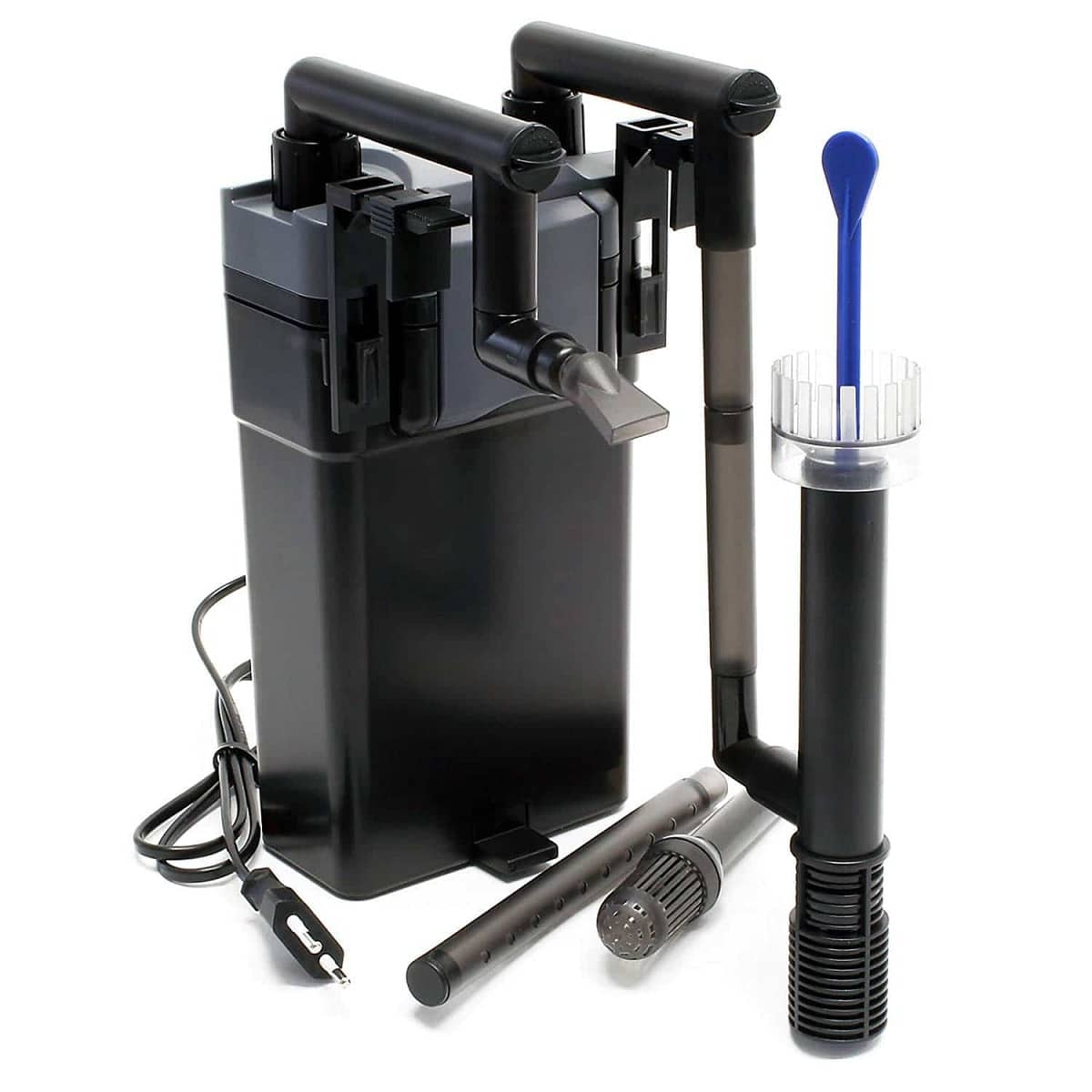
When it comes to cleaning the filter, some questions arise, especially regarding how to preserve the beneficial bacteria colonies . Let's see how to properly clean the external filter without disrupting the aquarium's balance.
If you're going to replace one of the filter media, it's not recommended to replace more than one at a time . Doing so could result in the loss of a significant amount of nitrifying bacteria necessary for good water quality.
To clean the foam filter (mechanical sponges), always use aquarium water , never tap water, as the chlorine in tap water could kill many of the bacteria. The goal is the same: to preserve the beneficial bacteria colonies. Simply squeeze the sponges gently in a bucket of aquarium water until they release most of the accumulated dirt, but don't leave them completely spotless.
Biological filter media doesn't need to be changed frequently, as it can last for years. It's only advisable to rinse it lightly if it becomes very dirty, again using aquarium water. Never scrub it or leave it completely clean; just remove excess debris so the water can circulate properly.
It is advisable to constantly reinforce the bacterial population , especially in young aquariums. Each time you clean the filter, it's best to add new commercial bacteria using one of the products recommended for this purpose, always following the manufacturer's instructions.
As for chemical materials like activated carbon, their lifespan is limited. They tend to become saturated within a few weeks, so it's best to remove or replace them after they've served their purpose (for example, after removing medications). Keeping them in the filter for too long provides no benefit and takes up space that could be used for biological material.

Choosing the right model depending on the tank size, the amount de peces The type of setup, correctly configuring the filter materials, and respecting maintenance times will ensure that the filter works for you, allowing you to focus on enjoying the aquarium day by day without any surprises.
