

When we start an aquarium and introduce fish, guppies are a very common choice. They are one of the best-known and most popular fish, especially among those new to the hobby. However, many people have questions about the differences between male and female guppies.
In this article we'll tell you all about the characteristics of the guppy fish and the differences between male and female guppies , with visual tricks, care guidelines and tips to avoid stress and overpopulation problems.
Guppy fish

These fish are tropical and live in freshwater. They are native to South America and belong to the Poeciliidae family. They are quite popular due to their striking colors; in fact, they are also known as millionfish because of the enormous variety of shapes and patterns available in aquariums. There are almost 300 varieties of these fish worldwide , and nearly all of them have different colors, sizes, and tail shapes.
Guppies are generally very peaceful animals that swim in groups at all times. They are active swimmers and you'll practically always find them moving. It's recommended to keep four guppies in an aquarium for every 50 liters of water. This way, they'll have enough space to meet their needs and live with other fish . Their lifespan is usually several years under good conditions, with quality water and a varied diet.
We often see males chasing females to impress them. Ideally, for these fish to interact naturally, the ratio should be one male for every three to four females . This reduces constant harassment from the males and prevents the females from becoming stressed. If you see your fish constantly hiding, it's a sign of illness or excessive stress . Stress is usually caused by overcrowding in the aquarium, poor water quality, or unmet needs.

Differences between male and female guppy fish

There are clear differences between male and female guppies. First, males are smaller than females and usually display more intense colors . They are also distinguished by their anal fin, which is modified into a copulatory organ called a gonopodium.
Their sexual differences are not so different from humans, as they possess one X and one Y chromosome. The XX combination produces females; the XY combination results in males. Guppies reach sexual maturity at 3-4 months, at which point the males already display gonopodiums and distinct coloration.
Size
Females are usually larger (approximately 4-5 cm or more depending on the line), while males are around 2-3 cm . This indicator is quick and useful in juvenile groups, although it is always confirmed with the other characteristics.
Her first book of poems, Cuerpo,
The male's gonopodium is an elongated anal fin used to transfer sperm to the female. The female lacks a gonopodium and has a short, fan- shaped anal fin . The male's belly is slender and streamlined; the female's belly is more rounded, and a dark pregnancy spot may be visible near the anal fin when she is pregnant.
fins
In males, the dorsal and caudal fins are usually longer, wider, and patterned, with shapes such as veil tail, lyre, or triangular. In females, the fins are shorter and more inconspicuous , with less diversity of shapes in the caudal fin.
Color
Males are distinctly more colorful and display patterns on their bodies and tails. Females generally have a more subdued or duller body, with some color concentrated in the caudal fin, according to the line. This dimorphism is one of the quickest identification keys.
Guppy fertilization is internal: the gonopodium is inserted into the female's genital opening, releasing sperm. The eggs then develop in a cavity within the female's abdomen. Guppies are ovoviviparous , meaning the eggs form and mature inside the female until they hatch and fully formed fry are born.
Differences in color
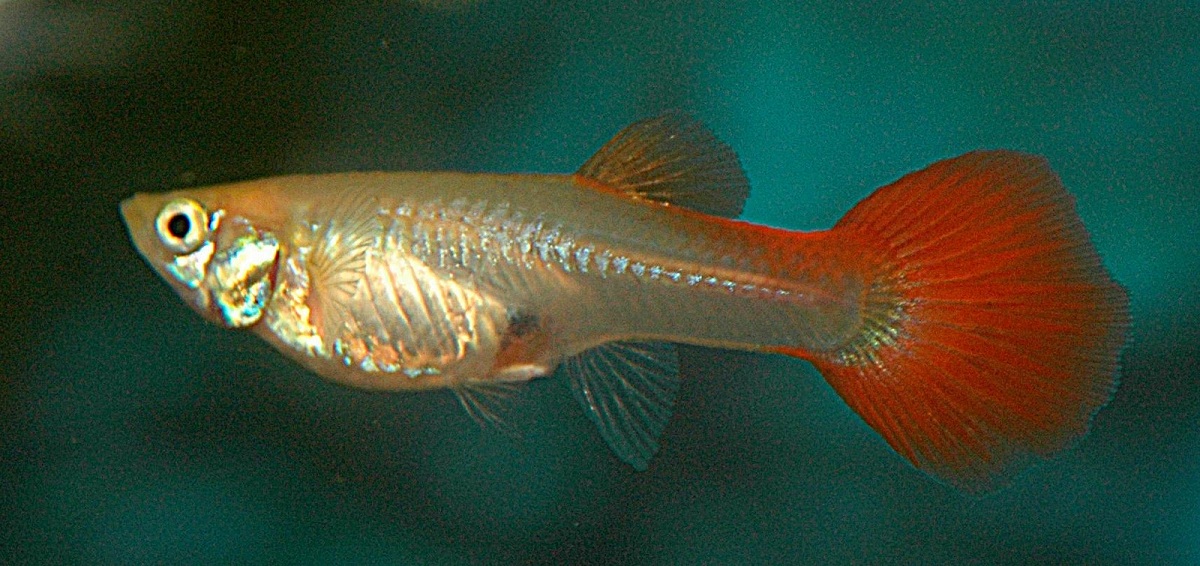
We can also find differences in color. There are countless combinations of these. de pecesAs we have mentioned, these fish are called de peces rainbow. It's most common to find a paler color on the upper half of the fish and a brighter color on the back, especially in the tail finwhich is one of its defining characteristics.
Some varieties have a metallic appearance because they possess iridophores . These are colorless cells that reflect light, creating the attractive iridescent effect. Although some lines have males with more subdued coloration, males are generally more brightly colored than females. This characteristic, combined with the gonopodium, allows for accurate sexing.
To avoid stressing the fish, the ideal ratio is one male to three to four females . Otherwise, you'll have problems in the aquarium due to excessive stress. On the one hand, the females receive more harassment; on the other, the males feel more pressure to compete with each other if there are few females in the group.
Reproduction
Understanding the differences between male and female guppies is essential for breeding these fish in an aquarium. The fry incubate inside the female's womb. Gestation lasts approximately 28 days , but this can vary depending on temperature, nutrition, the female's age, and stress level. Generally speaking, in warmer waters within their natural range, the gestation period may be a few days shorter.

The female can give birth to anywhere from a few dozen to over 100 fry , depending on her size, age, and genetic line. At birth, the fry are around 4-6 mm long, and from that moment they can feed on food appropriate for their size (crushed flakes, micro-food, or brine shrimp nauplii).
It's important to remember that guppies can eat their own fry . How do we save the fry? A few days before they are due to hatch, it's best to move the female to a small aquarium or breeding tank and place floating plants or mosses in the main tank to provide shelter for the fry. Once she gives birth, return the female to the main aquarium to prevent her from eating the young.
For optimal care of these animals, the following aquarium characteristics are recommended:
- Temperature of the aquarium between 18 and 28 ºC.
- pH of water in values of 7-8.
- El dGH (hardness) from 10 to 25 °GH.
- Food 1 or 2 times a day.
- Water changes weekly minimum of 25%.
As an added benefit, it helps to incorporate a filter and aerator to keep the water clean and well oxygenated, as well as abundant vegetation, including floating plants that increase the feeling of security and reduce stress.
Food

Guppies are omnivorous and will accept a wide variety of foods: quality flakes, freeze-dried food (mosquito larvae, salted shrimp), frozen food , live food, and vegetables. Alternating food sources enriches their diet, enhances their color, and improves reproduction.
A simple rule is to offer only the amount they can consume in about 2 minutes , 1-2 times a day. Avoid overfeeding: uneaten food will pollute the aquarium, increase nitrogenous compounds, and promote disease . For fry, provide small, frequent feedings of fine particles or nauplii, ensuring good water quality.
Aquarium recommended for guppies

Although they are small fish, they need space to swim and socialize. An aquarium of at least 40 liters is advisable to start with, allowing around 5 liters per fish for beginner setups. Larger volume provides greater system stability and fewer pollution spikes.
The aquarium should have live plants and hiding places. Floating plants help diffuse the light, reduce stress, and provide protection for the fry. It's recommended to use a biological filter appropriate for the tank's volume and ensure good aeration. Avoid using copper sulfate in the water, as it's harmful to guppies and other invertebrates.
Regarding coexistence, maintain a ratio of 1 male to 3-4 females to reduce harassment and allow them to swim in groups . Monitor parameters weekly and perform regular water changes to maintain their health.
Common health and diseases

Guppies are hardy fish if the water quality is good. When the parameters become unbalanced or there is overpopulation, bacteria and parasites appear. Among the most common problems are:
- White spot disease (Ich): White spots are observed on the body and fins; the fish may rub against objects and show rapid breathing.
- Velvet disease (Oodinium): fine velvety coating, whitish or golden; apathy and folded fins.
To prevent this, maintain a routine maintenance (water changes, gentle bottom siphoning, filter cleaning), avoid overfeeding, respect the density de peces y quarantine Examine new specimens before introducing them. Watch for signs of stress: folded fins, constant hiding, or loss of color.
Most common tail varieties and shapes
Guppies are distinguished by the shape of their tail fin and by their colors. Among the most common tails we find: fan, needle, flag, double sword, lower sword, upper sword, lira, shovel, tip, veil, Round y triangularAs for colors and patterns, there are lines Red, yellow, blue, green, black and patterns like mosaic o leopardThe guppy is also popular Endler, in bright and metallic colors.
Correctly identifying their sex, providing them with space, plants, and a varied diet will allow you to enjoy active guppies with vibrant colors and controlled reproduction. With basic care and attention to signs of stress, they become one of the most rewarding species for beginners and those new to the aquarium hobby.
