

When you have an aquarium, you have to decide which plants to put in it, both for its beauty and for their usefulness and function in the lives of your fish. Sometimes there is such a wide variety of plants (both live and artificial) that it's difficult to choose the right ones for your aquarium.
Throughout this comprehensive guide you will learn how to choose, combine and care for the best freshwater aquarium plants for every type of setup: community aquariums, cichlid-specific aquariums, nano aquariums , cold water aquariums, dense planted setups and even advanced aquascaping.
Here we'll show you some of the most outstanding plants available for all types of aquariums , as well as some that are more specific to certain species. We'll also include recommendations for fertilization, lighting, CO2, and substrates used in the most demanding planted aquariums, explained in a simple way so anyone can apply them. Want to learn more about aquarium plants?
The best aquarium plants

When we start decorating our aquarium, we always think about recreating the fish tank as closely as possible to the real thing. natural ecosystem where the fish lives. For this, it is necessary to have good aquarium plantsThere are plastic aquarium plants and live plants. If you're going to have live plants, you should know how to care for them, what water parameters they need, and which species are suitable. de peces you are going to have so that they can be in harmony in the same ecosystem.
In this article we'll talk about the best freshwater aquarium plants and give you some options so you can buy the one that best suits you based on your experience level, the size of the tank, the type of water (cold or temperate), and the type of aquatic landscape you want to create.
In addition, you'll see that many of these plants are not just decorative: they oxygenate the water , consume nitrates, provide shelter and spawning areas, help control algae, and make your fish feel much safer and less stressed.
Below we will show you some of the most popular models that are best suited to most types of aquariums that people usually use.
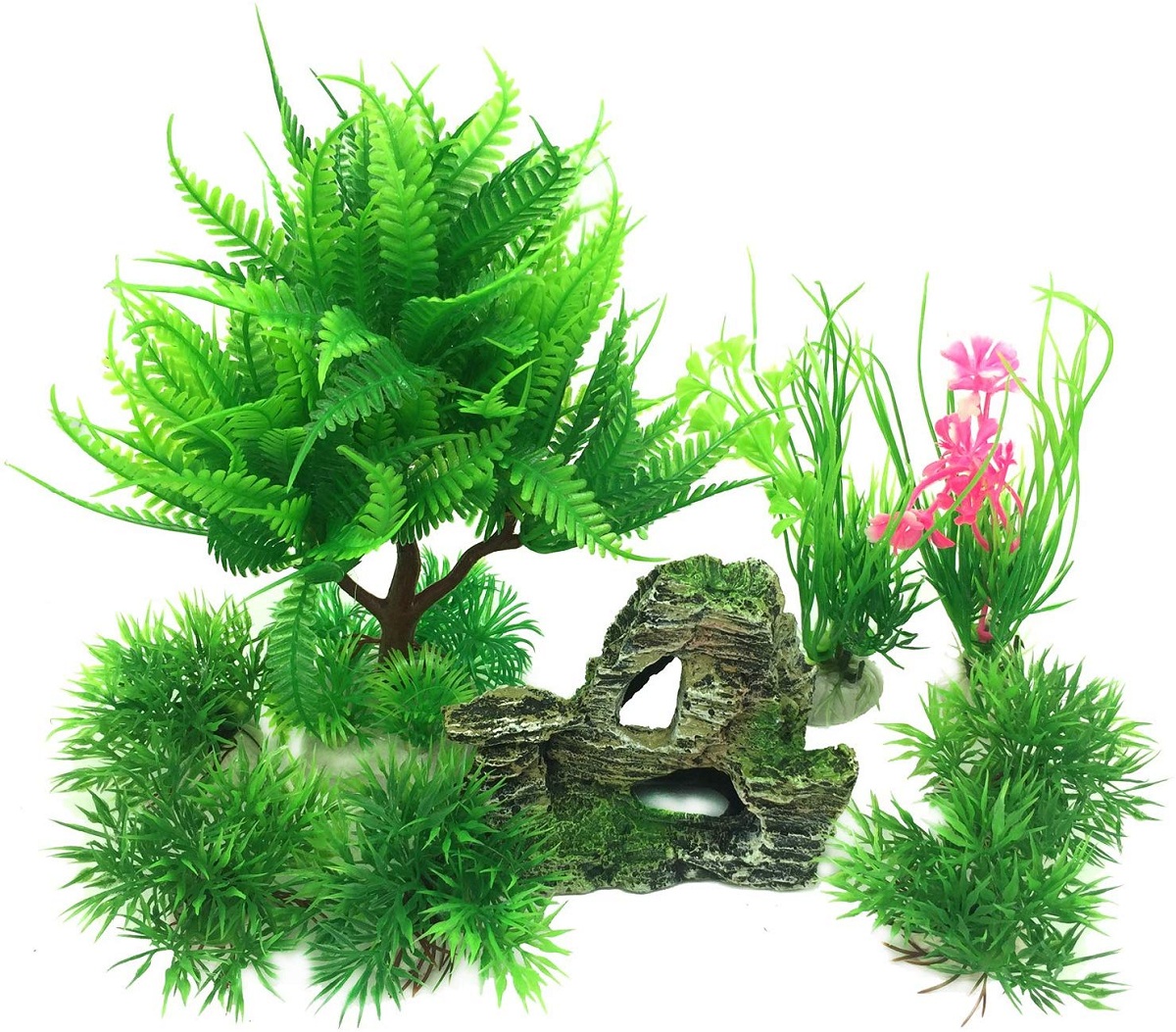
pietypet

We'll start with classic plastic aquarium plants . This model comes with a set of aquarium plants suitable for aquariums between 5 and 15 gallons in size. They have vibrant and detailed colors to add some life to the tank. They are designed to mimic real plants, making the fish's environment as close as possible to their natural ecosystem when we don't want to or can't use live plants.
This set includes an aquarium decoration and eight assorted green plastic plants . The plants come in various sizes, ranging from 5 to 18 cm, allowing you to create different heights and a sense of depth in your aquarium.
This material is completely non-toxic, so if a fish accidentally bites it, nothing will happen. It's made of plastic, resin, and a ceramic base. It's suitable for both freshwater and saltwater aquariums since it's unaffected by the tank's pH. It's a great option when you want low maintenance but still want an attractive decoration.
All the plants come with a small pedestal for placement, so they won't float in the aquarium. The decoration is quite realistic and can provide fish with a small shelter. You can purchase this model by clicking here.
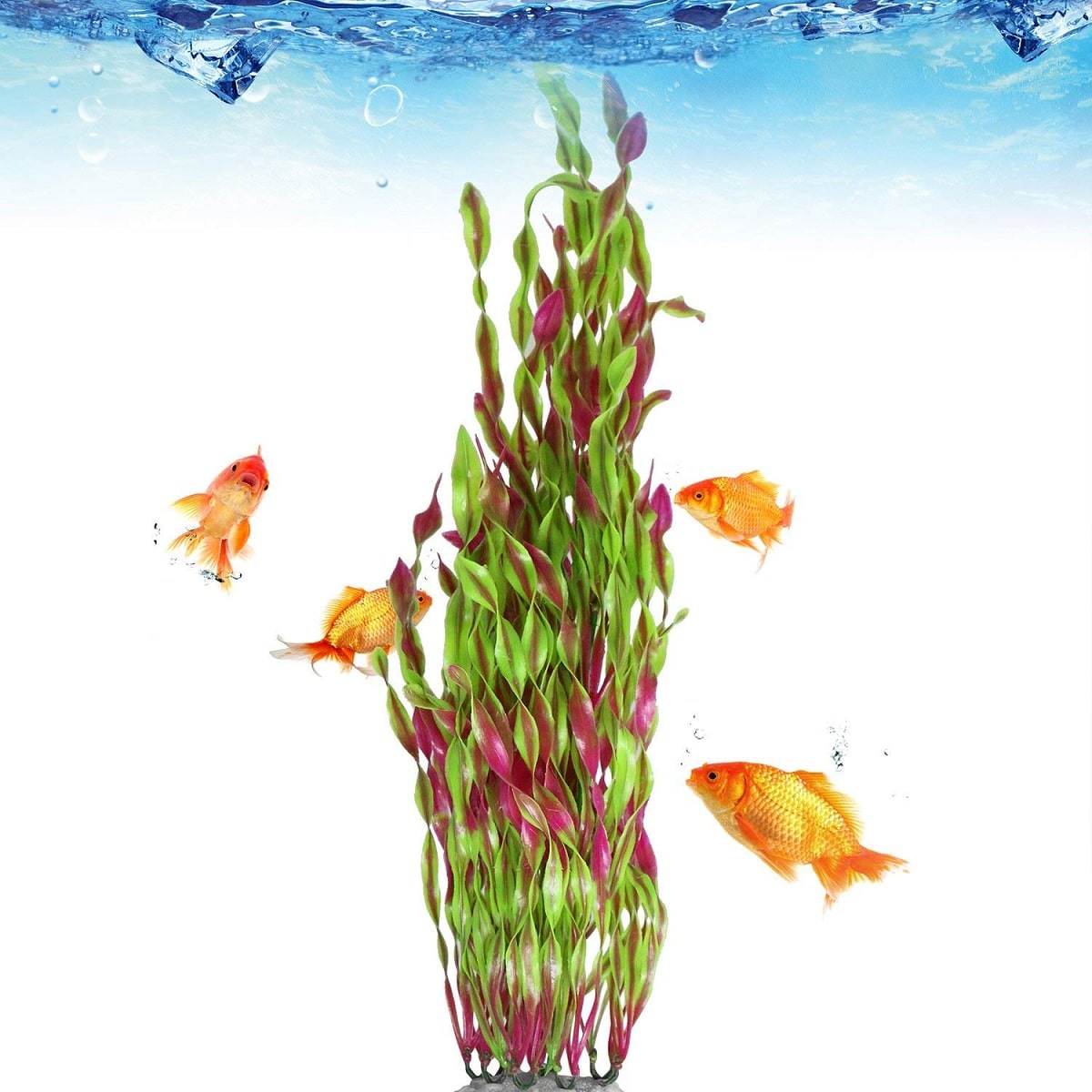
JDYW

This is another model that boasts durable features and is completely harmless to fish. It's a plastic plant with a ceramic base and no unpleasant odor. It won't harm fish or the aquatic environment . It also won't rust or rot, so maintenance is limited to periodic cleaning.
It's a very realistic plant that mimics the movement of plants in water thanks to the flexibility of the plastic. This makes the aquarium look much more natural, even without live plants.
It's the perfect height for the aquarium, with a base that ensures the plant's stability and provides fish with a place to play and hide. Its design makes it easy to clean when dirty; simply soak it in warm water to remove any debris.
It is 52 cm in size and weighs about 270 grams. The plastic is designed so that the plant can remain stable in the place you put it and not move with the movement of the water or swimming. de peces large. You can buy this plant by clicking.
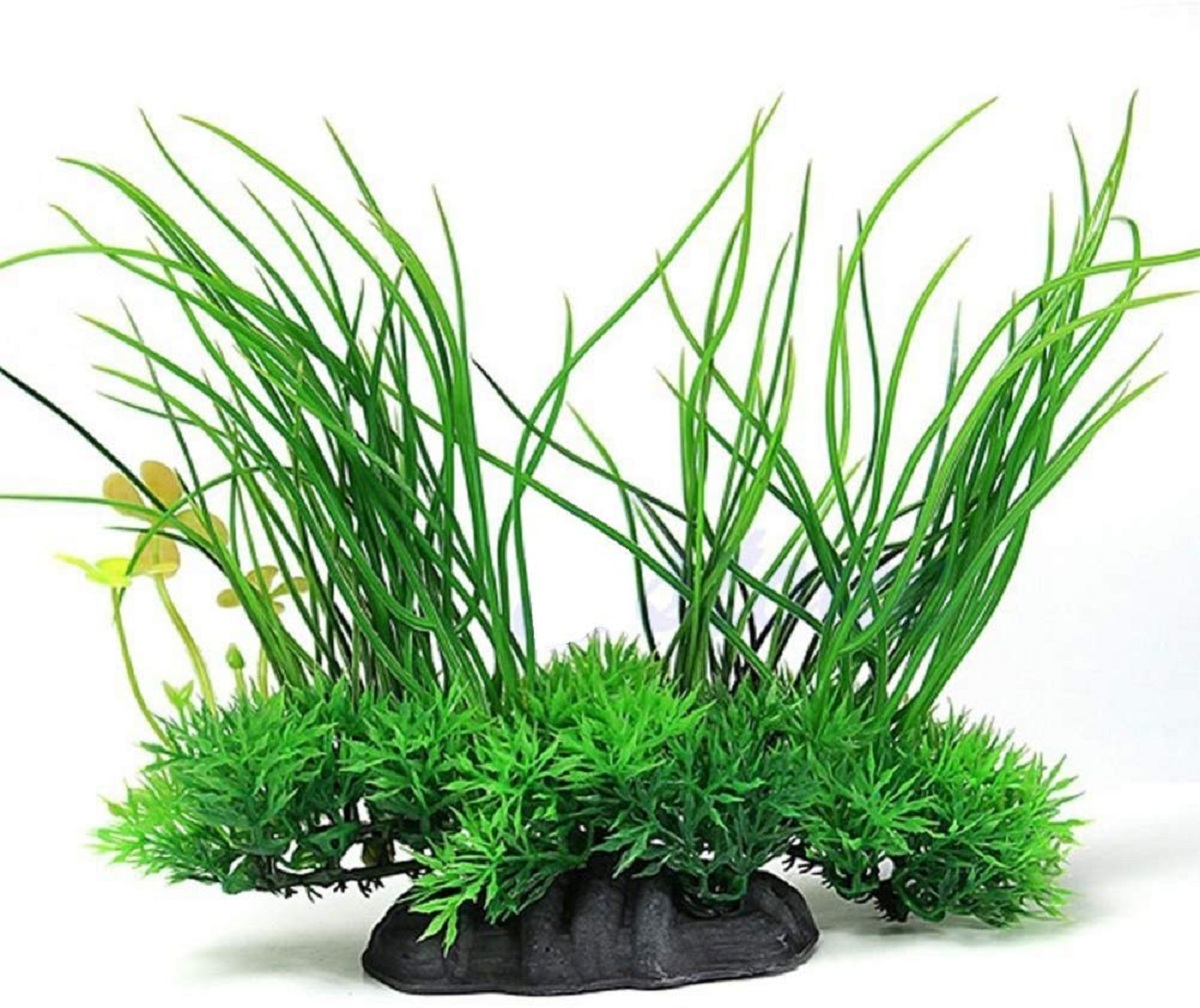
luoem

This is one of the perfect plants to place at the bottom of aquariums . It helps to create a background landscape, conceal filters, heaters, or tubes, and create a sense of lush vegetation without the need for live plants.
It has a natural green color and is made of plastic. It measures 20x8x16cm and weighs 200g . It can be used in both freshwater and saltwater aquariums and is non-toxic. It is very easy to clean and is an ideal decoration for your aquarium when you want to create the effect of tall plants without any hassle.
It features a ceramic base for added stability. It's quite durable and environmentally friendly, as it doesn't release any substances into the water. Get yours by clicking here.
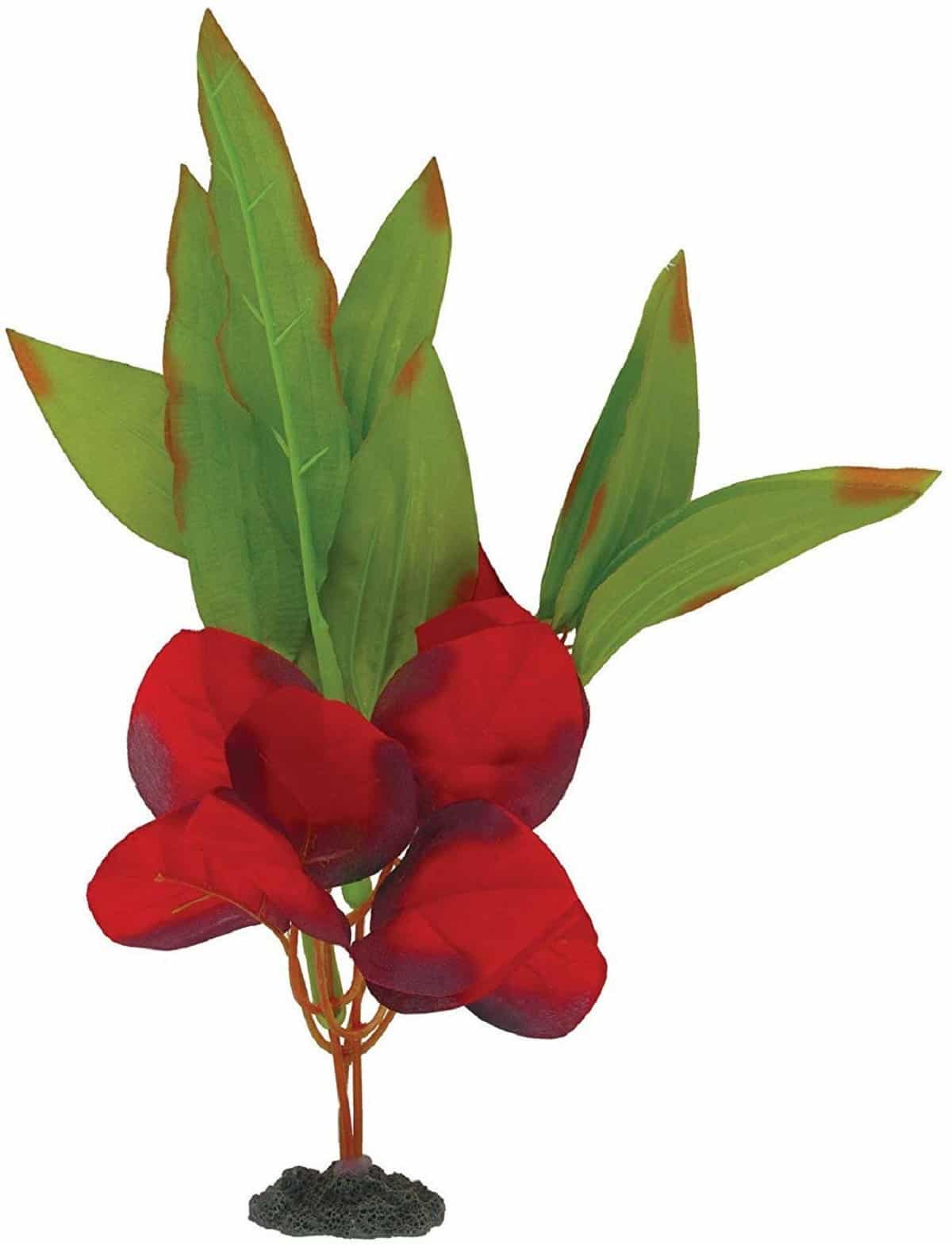
Marina Naturals

This model is quite realistic and has good lightfastness. It's one of the best models you can buy if you want to give your aquarium a more natural look without needing real plants or worrying about water parameters, fertilization, or pruning.
It's quite soft to the touch and completely safe for all types of aquariums. Its green and red leaves allow you to play with color contrast and combine it with other artificial plants or aquarium gravel.
It has green and red leaves. It can be a good match for other plants with more vibrant colors, creating a colorful display that also complements the fish. Get it by clicking here.
Types of aquarium plants
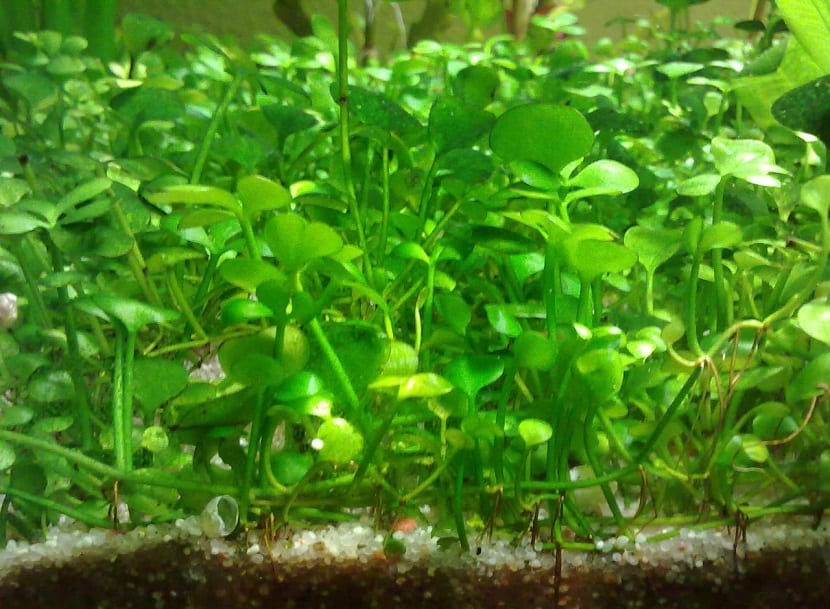
When we want to get plants for our aquarium, we often find ourselves overwhelmed by the many unfamiliar names, and sometimes it's difficult to know if a particular plant will be suitable for our fish. Plants (if they are truly viable) also require certain conditions, such as clean water , specific lighting , an appropriate aquarium size, a suitable substrate , and sometimes, CO2 injection and fertilizers.
One of the problems we encounter when choosing plants for our aquarium is that almost all of them come with their scientific names . This makes them much more difficult to recognize at first. However, this shouldn't scare us, as we will gradually get to know them and become more familiar with their shapes, colors, and typical positions in the tank.
In addition to classifying them by name, it is very useful to divide them according to their growth type and function within the aquarium:
- Plants of stem (such as Limnophila, Hygrophila, Rotala): grow upwards from a main stem.
- Plants of rosette or rhizome (Echinodorus, Cryptocoryne, Anubias, Bucephalandra): they start from a central point or thick rhizome.
- Plants upholsteryThey cover the floor like a carpet.
- Floating plantsThey live on the surface without taking root in the substrate.
- Mosses and fernsThey attach to rocks, logs or decorative elements without the need for a nutrient substrate.
We will begin by describing some types of plants based on their maintenance difficulty and their aesthetic appeal, which is ultimately one of the pillars of planting in a home aquarium.
Plants for the cycling process

The first thing we need to do when starting a new aquarium from scratch is to establish a bacterial colony that will perform its cleaning functions. This function is based on transforming waste into compounds that are harmless to our fish. This process is known as [missing information - likely "bacterial growth" or "bacterial growth"].
The cycling process takes approximately one month , so during this time we cannot introduce any fish into our aquarium, as the water will be toxic to them due to the presence of ammonia and nitrites. During this period, plants are invaluable.
During the cycling process, we can introduce plants that help improve and accelerate the process. Plants consume ammonia, nitrites, and especially nitrates, which can be toxic to fish at certain concentrations. They also help stabilize the pH and provide shelter for beneficial microfauna.
The most suitable plants for this process are those of rapid growththat oxygenate the water and are large consumers of nitrates. They don't require much care; they are plants of easy maintenance and highly recommended for both beginners and heavily stocked aquariums de peces.
For example, we find two types of plants that work particularly well for the cycling process:
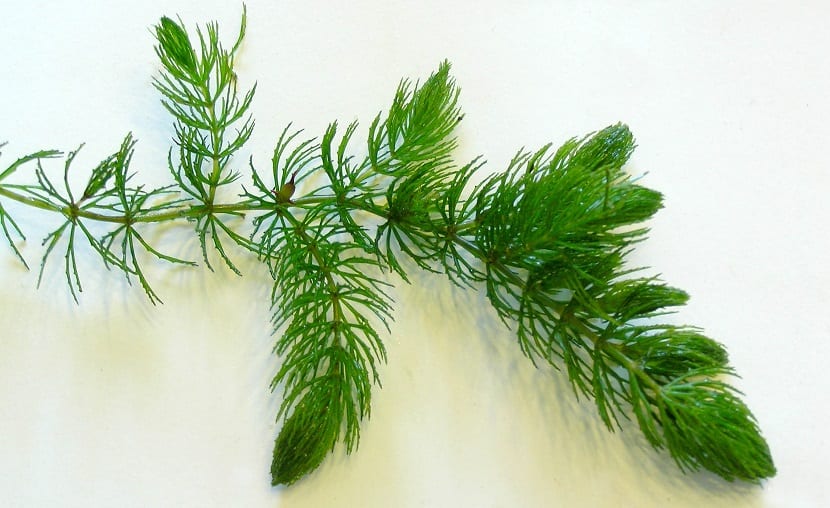
- The first is the foxtail (Ceratophyllum demersum)It's a very easy plant to care for, grows very fastIt requires little light and does not need CO2 injection. It can be used as a floating plant or lightly planted in the substrate, where it is actually held in place by its own weight since it does not develop true roots.
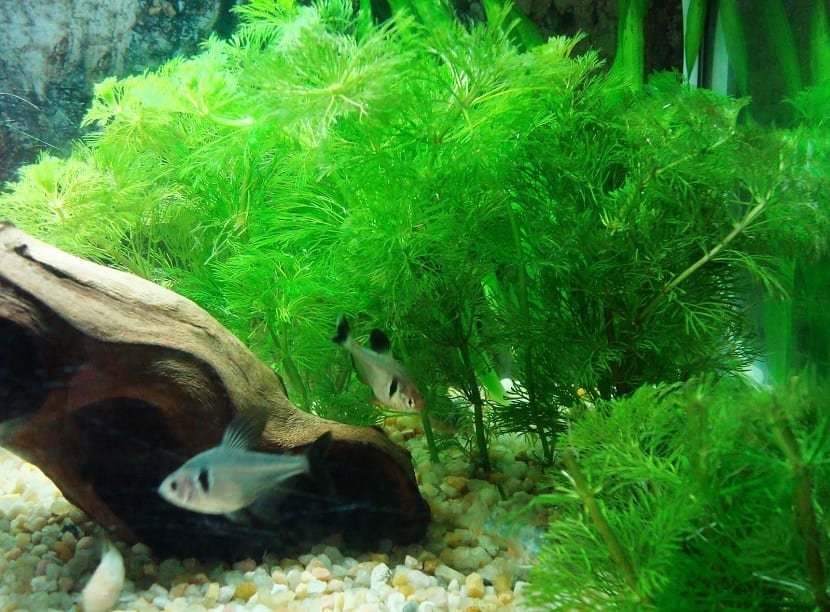
- The second is the ambulia (Limnophila sessilifloraIt needs a little more light than the previous one, but it's also easy to care for, it grows fast and it is more eye-catching thanks to its fine, feathery leaves that add volume to the back of the aquarium.
In addition to these two, many stores specializing in planted aquariums recommend other fast-growing stem plants for cycling, such as Hygrophila polysperma or Elodea/Egeria densa , which work similarly: they grow quickly, consume large amounts of nutrients, and compete with algae from day one.
Plants that require little light

If you're new to the world of aquariums, it's best to start with plants that require little light . These plants typically require less care and maintenance. If you're just starting out, you'll already have enough to worry about just learning to care for the fish without having to worry about extremely delicate plants as well.
These plants thrive simply by being submerged in the aquarium. They will feed on fish waste (usually nitrates), some of the food we give them (phosphates), and in many cases, they will hardly need any light to grow. A little general fertilizer will help them grow stronger; this should be added periodically, but without overly complex monitoring.
In general, low-light plants are ideal for community aquariums , for aquariums with fish that eat delicate plants (such as some cichlids), and for those who don't want to invest in very powerful lights.
The fertilizers we should use are those that provide potassium and micronutrients , applying them once or twice a week:
- Aquili basic liquid fertilizer: Simple and economical fertilizer that provides essential nutrients that are often lacking in aquariums with few plants or infrequent water changes.
- Seachem Florish fertilizer: Seachem's most advanced fertilizer, with a very complete range of micronutrients and trace elements for densely planted aquariums.
Among these plants that require little light, we find some that are truly essential in aquariums:
- Java fern (Microsorum pteropus): Present in most aquariums by your resistance and its ease of maintenance. Its growth is moderate and it does not require CO2 injection. It attaches easily to rocks and logs, so it doesn't even need a nutrient-rich substrate.
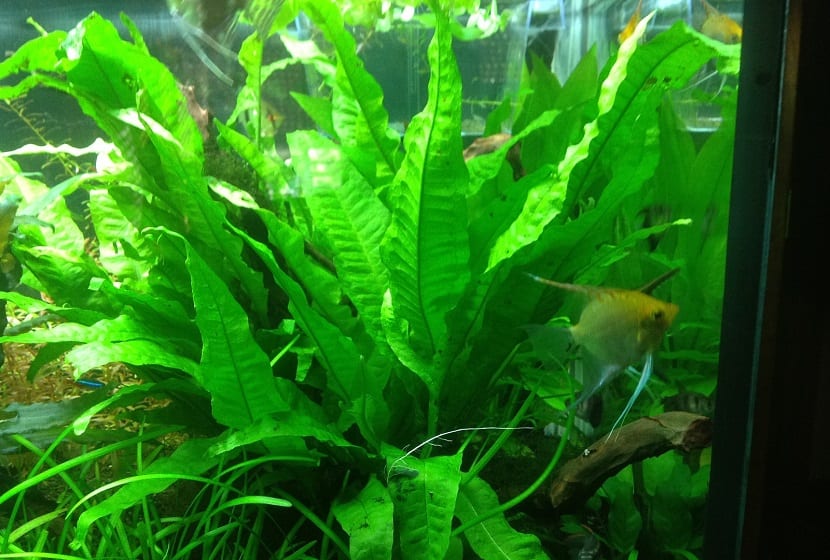
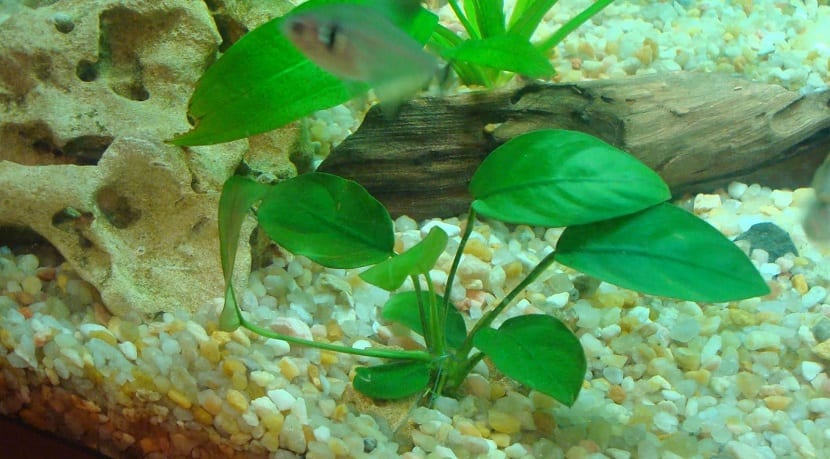
- Anubia barteriThis is the most commonly used variety of Anubias. It requires no complicated care and has large, rounded leaves. It tolerates hard water and low light, and is perfect for aquariums with restless fish because its leaves are very resilient.
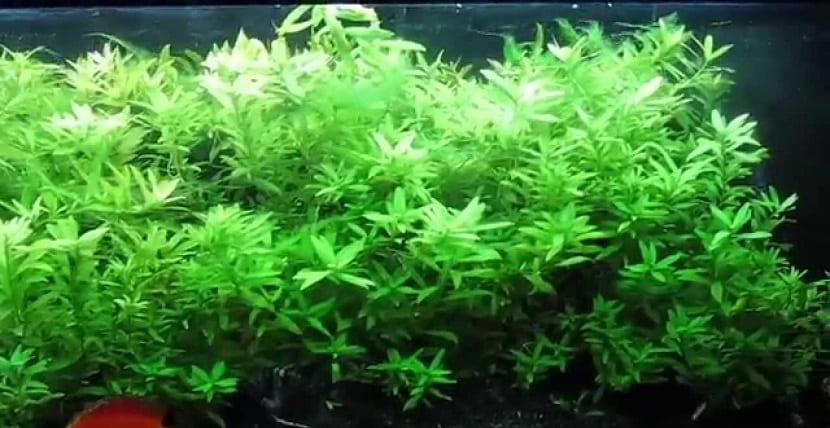
- Hygrophila polysperma: Resistant plant, with small leaves and a stem that can grow very tall. With good lighting, its upper leaves turn reddish in color. Serves as a marker of potassium deficiencybecause it yellows and develops holes easily when this nutrient is lacking.
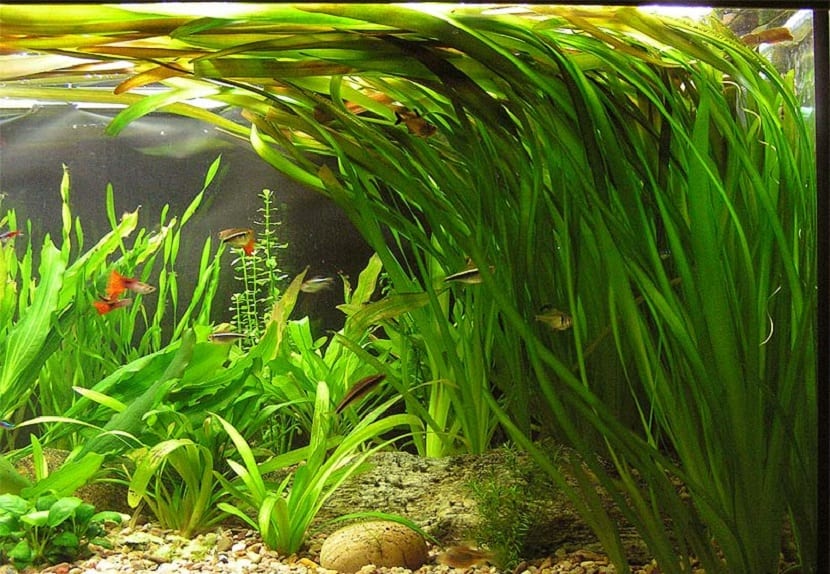
- Vallisneria Americana GiganteaThis plant has ribbon-like leaves; this variety has wider leaves. It propagates easily through the substrate by sending out new runners, making it good for creating curtains at the bottom of the aquariumIt accepts medium-low light and is very durable.
This group of low-light plants also often includes species such as aquatic mosses (for example Java moss, Taxiphyllum barbieri), Bucephalandra or small varieties of Anubias (such as Anubias barteri nana), which are highly sought after in modern planted aquariums for their compact aesthetic, interesting colors and ease of maintenance.
Aquarium plants according to the position they will have

At first, if we're new to the world of aquariums, any plant will do, and we're happy as long as our fish are healthy. However, as we delve deeper into the world of aquariums, we want to include more types of plants and become more interested in the overall design of the tank.
To avoid placing plants haphazardly or without prioritizing them, we'll create a list of plants based on their size and their optimal position within the aquarium. In aquascaping, the aquarium is typically divided into foreground, middle, and background zones, each with its own preferred plants.
Forward position plants
The front of an aquarium should be the most attractive, as it's the area most visible to the public or simply the one most often seen on a daily basis. Therefore, the plants chosen for the front should be the most striking and selected with greater care. The other plants "protect" these, so they tend to be quite prominent in any aquascape design.
The most beautiful plants for the foreground of the aquarium are low-growing carpeting plants . These plants cover the substrate evenly, creating lovely meadows. The problem is that, generally, these plants are more demanding. They require more light, more frequent fertilization, CO2 injection, a nutrient-rich substrate, and good water circulation.
Everything that looks good comes at a price, but there are also less demanding options that allow you to achieve a carpet effect without setting up an extremely technical aquarium. There are also carpeting plants that don't require as much care, so you won't have to make a huge investment.
Here are some of the most commonly used ground cover plants :
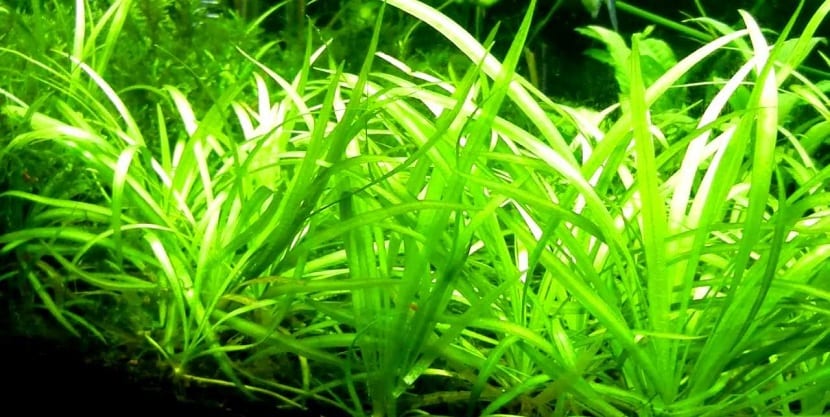
- Sagittaria subulataThis plant does not require additional CO2 or much light. It is the easiest upholstery plant to maintainIt reaches a medium height, spreads easily by stolons, and, if left to grow, can form a wild-looking meadow.
- Glossostigma elatinoidesThis plant does require extra CO2 for its maintenance. It also requires high lighting and a fine, nutrient-rich substrate. It has rounded leaves and It is widely used as a wallpaper because of its beauty and tiny size, which creates an extremely fine grass effect.
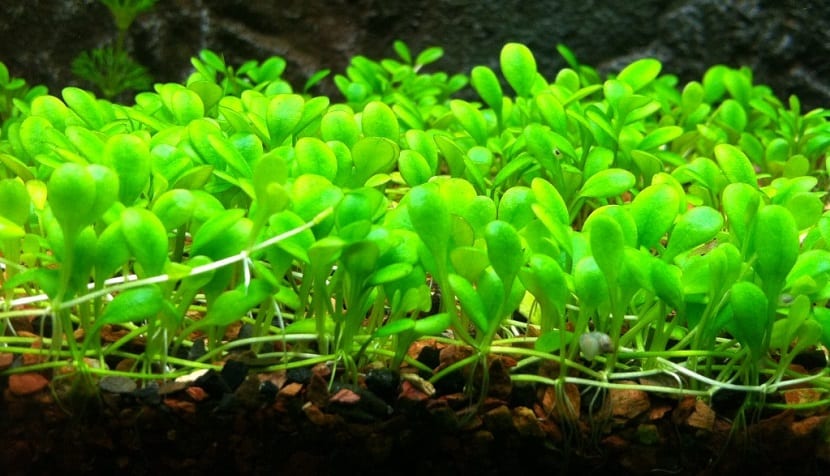
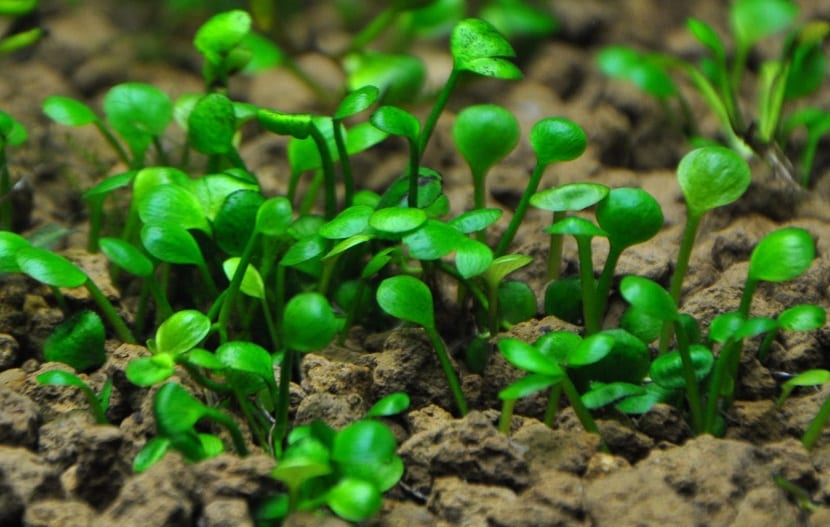
- Marsilea hirsutaFor this plant, it is recommended to add extra CO2 and medium lighting. It spreads throughout the substrate, including areas with less light. It produces 2 to 4 leaves depending on the amount of light it receives. It is more tolerant than other fine carpeting plants and can withstand minor beginner mistakes.
In cold water setups or with moderate lighting, Eleocharis acicularis , which we will mention later, can also be used as a carpeting plant with a lawn-like appearance, although its stature is usually somewhat taller.
Medium height plants
Medium-sized plants are used for various purposes. If carpeting plants are unavailable, they can be used to create shrubby areas without obstructing the back of the aquarium. They also serve as a transition to the back of the aquarium, softening the change between the front and back.
There are various types of medium-height plants depending on their requirements for light, CO2, and fertilization. They are usually placed in front of taller plants and behind ground cover plants to create a layered effect.
Here are some examples :
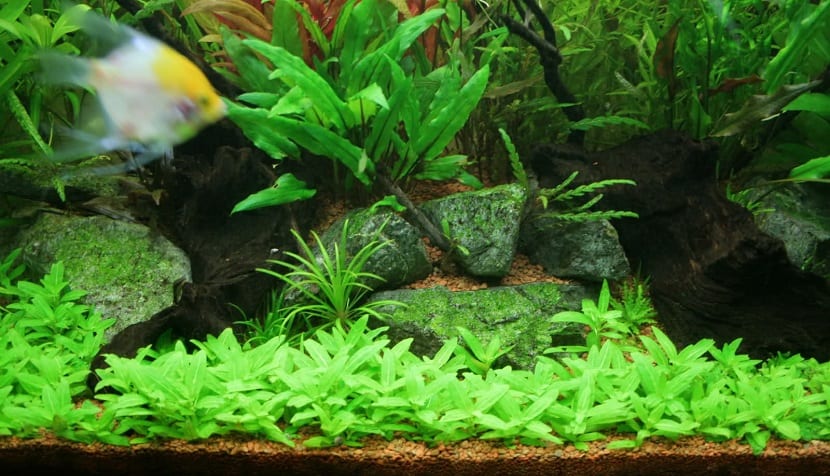
- Staurogyne rubescensThis plant doesn't require much light, but adding CO2 is recommended for better compaction. It's a medium-height shrub, growing no more than 5-6 cm tall under good conditions. Its long, green leaves create dense clumps that are very popular in aquascaping.
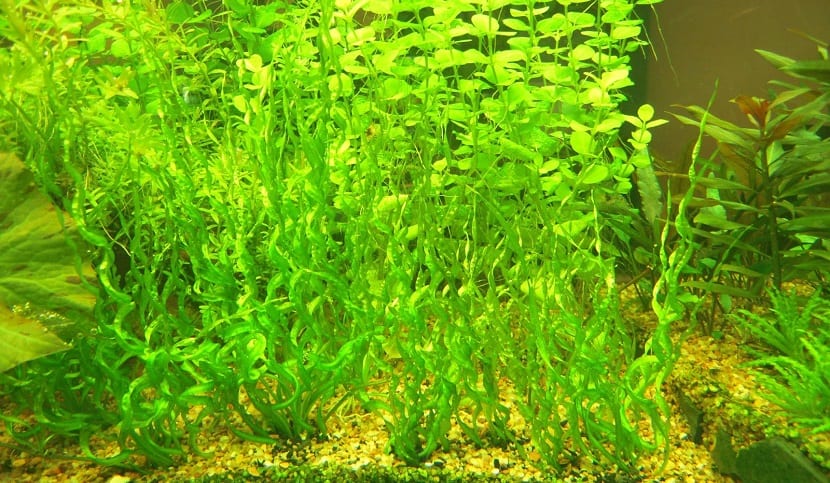
- Echinodorus 'Vesuvius'This plant does not require additional CO2 and has very curly, narrow leaves that add a lot of visual movement. It is perfect for the midground of the aquarium or as a focal point in front of more robust plants.
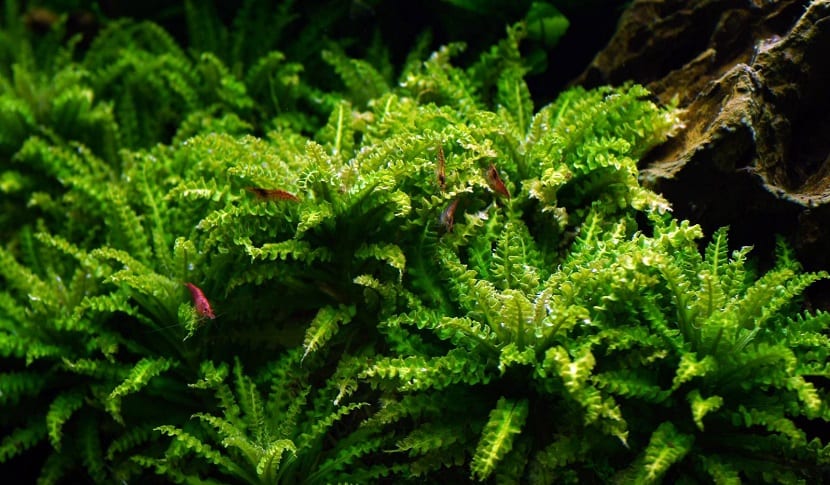
- Pogostemon helferiThis plant is well-known in aquascaping for its unique shape. Its wavy, compact leaves give it a striking green star-like appearance. It can be used as a midground plant or even as a carpeting plant. Supplemental CO2 is recommended, and it requires medium to high light to maintain its compact shape.
Anti-algae and aquarium plants with cichlids

The foxtail plant mentioned earlier works perfectly as an algae control plant because it grows very quickly and consumes a large amount of nitrates. It's a plant that will need to be pruned frequently due to its rapid growth, which also prevents it from becoming too dense and blocking water circulation.
Other fast-growing plants, such as Elodea/Egeria densa , Hygrophila polysperma , or even Limnophila sessiliflora , are also considered excellent algae-fighting plants because they transform dissolved nutrients into plant matter useful for the aquarium.
Regarding people who like to take care of others African cichlids American fish owners should know that many of these fish feed on aquarium plants or uproot them while digging in the substrate. Some like to dig in the gravel, which loosens the plants, or their swimming can even damage and dislodge them. Therefore, plants that are suitable for this type of aquarium are necessary. de peces.
Among them we find:
- Java fern (mentioned above): it attaches itself to logs and rocks, so it is not uprooted when cichlids burrow.
- Anubia barteri (also mentioned above): its thick rhizomes attach to hard decorations and its tough leaves better resist gnawing.
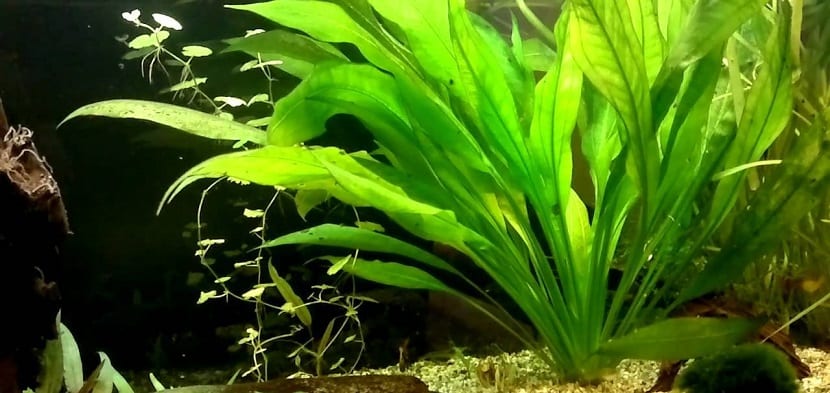
- Amazon sword (Echinodorus amazonicus): A well-known plant in aquariums due to its easy maintenance, it has long, sword-shaped leaves. It does not require external CO2.It attaches well to the substrate and doesn't need much light. In aquariums with cichlids, it's advisable to protect its roots with stones or plant it in areas where the fish dig less.
In aquariums that are very aggressive towards the substrate, it is also a good idea to prioritize plants rooted in logs or rocks (Anubias, Microsorum, Bucephalandra, mosses) and floating plants, which are impossible to unearth.
Cold water algae

When we refer to cold water aquariums, we mean those without a heater . In these types of aquariums, the fish tend to be more resilient and are often primarily vegetarian, so we must ensure that any plants we add are especially resistant to nibbling and lower temperatures.
Coldwater plants must tolerate a wider temperature range , from cool environments in winter to somewhat warmer temperatures in summer, especially in indoor aquariums without temperature control. They must also perform well under standard lighting, as many coldwater aquariums do not have high-powered fixtures.
Here are some plants that can tolerate cold water :
- Foxtail (Ceratophyllum demersum): perfect for ponds and aquariums without a heater, withstands the cold well and helps to oxygenate.
- Java fern (Microsorum pteropus): very versatile and resistant to low temperatures.
- Anubia barteriIt tolerates both cold and temperate waters and grows slowly.
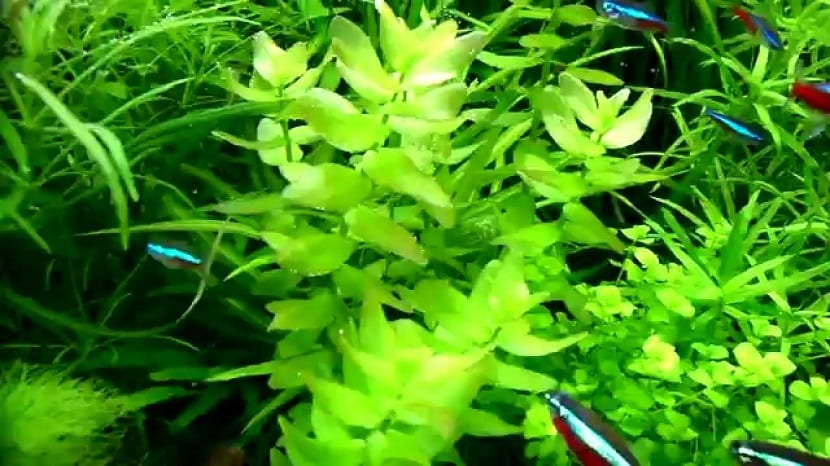
- Bacopa caroliniana: Plant with a fleshy stem and leaves, quite resistant and suitable for cold waters. With good lighting, its upper leaves turn orange. It does not require external CO2.
- Vallisneria Americana GiganteaIdeal for large aquariums or ponds, it forms long ribbons that provide shelter.
- Amazon sword (Echinodorus amazonicus): tolerates a certain range of temperatures, provided the changes are not abrupt.
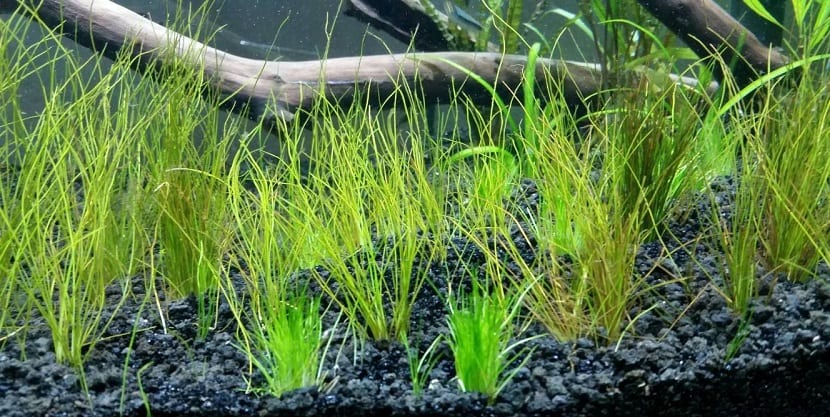
- Eleocharis acicularisA carpeting, lawn-like plant with medium light requirements and a medium size that tolerates low temperatures. It does not require external CO2 and is perfect for creating carpets in well-lit, cold-water aquariums.
There are many plants suitable for freshwater aquariums. We've only focused on the most common and widely used ones; however, they come in all shapes and colors. It's also important to research the specific plant requirements of certain fish , as some need a particular type of plant to survive, spawn, or simply feel comfortable.
Upholstery plants
Carpet plants are those placed at the front of the aquarium. Therefore, they should be the most attractive. They are the ones that will be visible at first glance and that define the style of the aquascape in most planted aquariums.
The plants we choose for the front should be the most eye-catching. They need to be carefully selected to optimize the overall look , the sense of depth, and the harmony with the other plants at mid-height and in the back.
The best are low-growing ground cover plants . These can cover the substrate evenly and create beautiful meadows. Generally, if they are true plants, they are among the most demanding in terms of light, CO2, and substrate quality.
Some of the most popular items for freshwater aquariums are:
- Eleocharis acicularis and Eleocharis sp. mini: lawn effect, easy to cut and maintain.
- Glossostigma elatinoides: already mentioned, very fine and professional-looking.
- Marsilea hirsuta: a ground cover with somewhat slower growth and tolerance.
- Hemianthus callitrichoides «Cuba»: extremely fine and compact, widely used in advanced aquascaping (requires high light and CO2).
Plants without substrate
When we talk about a plant that doesn't need soil, we mean that it doesn't need to absorb nutrients through buried roots . It can thrive in any inert gravel or even without being planted at all. These plants don't need to be planted in soil; instead, they root in various decorative elements such as logs, rocks, ceramics, or artificial ornaments.
This group would include, for example, Anubias , Microsorum pteropus (Java fern), Bucephalandra , and many aquatic mosses (Taxiphyllum, Vesicularia, etc.). These species absorb most of their nutrients directly from the water through their leaves and rhizomes.
This way, you can have a beautiful decorative element with real plants without needing a substrate that requires high-quality maintenance. It's the preferred option for aquariums with digging fish, shrimp tanks, or cichlid tanks where the substrate is frequently stirred.
Rooted plants
These are plants that come already rooted in wood or rocks . They offer a simpler way to add natural decoration to your aquarium, as you simply place the pre-planted log or rock in the desired location.
With these types of plants, you don't have to wait for them to grow to be seen; they'll provide a great ornamental touch from day one. It's very common to find logs planted with Anubias, Bucephalandras, or Java ferns in stores, as well as rocks covered in Java moss.
Furthermore, this "ready-to-install" format is highly recommended for beginners who don't want to get bogged down with anchoring techniques (thread, special glues, etc.) and want quick visual results.
Red plants
Red is always a good color for our aquariums because it offers a very attractive contrast with the green of most plants. Introducing some red plants in strategic areas (generally the middle or back of the aquarium) adds depth and a powerful focal point.
Among the most important red aquarium plants are the following:
- Alternanthera reineckii
- Ammania senegalensis
- Echinodorus Red Devil
- Cryptocoryne albida "Brown"
- Echinodorus Red Diamond
- Echinodorus Ozelot
- Ludwigia repens "Rubin"
- Echinodorus Hadi Red Pearl
- Echinodorus Fancy Twist
- Echinodorus Red Chameleon
Many of these red plants require good light and fertilization , and in some cases CO2 as well, to display their full, intense color. In low light conditions, they tend to turn greenish or lose their vibrant red hue.
Easy to care
Many people look for easy-care plants when introducing live plants into their aquariums. Ideally, you should start with hardy species that can tolerate beginner mistakes, variations in water changes, or even occasional lapses in lighting.
Here is a list of the easiest to maintain, which practically any aquarist can keep:
- Cryptocorynes: very wide variety of shapes and colors, they grow slowly but are very robust once adapted.
- Echinodorus: "Amazonian swords" are simple and very rewarding if they have some nutritious substrate.
- Anubias: probably the most recommended plants for beginners.
- ambulance (Limnophila sessiliflora): rapid growth and feathery appearance.
- Vallisnerias: easy, decorative and multiplying by runners without stopping.
- Hygrophila polyspermaIt tolerates almost everything and grows very quickly.
- Java fern (Microsorum): ideal for aquariums with low light or with fish that move the substrate.
- Aquatic mossesJava moss, Christmas moss, etc., are almost impossible to kill with moderate lighting.
Oxygenating plants
These are plants that, thanks to their metabolism and growth rate, provide extra oxygen to the water. Aeration is important for maintaining the health of the fish, and although the filter and surface agitation already help, plants are a perfect complement.
Here are some of the best oxygenating plants for freshwater aquariums:
- Ceratophyllum demersum (fox tail): very fast in consuming nutrients and producing oxygen.
- Egeria densa (also known as Elodea): extremely used in ponds and aquariums for its effectiveness.
- hottonia palustris
- Myriophyllum brasilensis
- Myriophyllum aquaticum
- Orontium aquaticum
- Ranunculus aquatilis
- Vallisneria gigantea
Maintaining a healthy and actively growing plant mass improves the overall water quality, provided we maintain a reasonable balance between plants, fish and food.
Other Aquarium Plant Considerations

When we have an aquarium at home , in addition to taking care of factors such as temperature, pH, acidity, hardness, and filtration, it's important to pay attention to the plants in our aquarium. These plants must remain in good condition to prevent any health problems for our animals or the proliferation of bacteria and fungi in decomposing plant matter.
It's very important that the plants in your aquarium remain alive and in perfect condition so that the fish feel comfortable in their habitat, can hide among them, or even feed on them when appropriate. Keep in mind that aquarium plants should be very fresh and vibrant when purchased. Avoid yellowing specimens, plants with melting leaves, or plants with damaged roots.
That's why we're bringing you some recommendations so that plants can fulfill their function within your pond or aquarium.

As a first step, for the plants to thrive, they need ample light and CO2 . If either of these factors is insufficient, it's not advisable to apply large amounts of fertilizer, as the substances could accumulate excessively and feed the algae. In these cases, you can add a small amount of potassium, as it's a nutrient that rarely causes algae problems on its own.
In the case of floating aquarium plants , as their leaves begin to emerge above the surface and get closer to the light, they can block the light from reaching other plants inside the aquarium. Therefore, we recommend that you don't let them grow too large so that the smaller plants can also benefit from the light from the lamp or indirect sunlight.
Similarly, we recommend using gravel that measures between 3 and 5 millimeters , as finer, smaller gravel can suffocate the plant's roots, causing them to rot and die from lack of oxygen. Also, while neutral pH water is suitable for most community aquariums, remember that many plants prefer slightly acidic water for optimal growth. Learn more about substrate types at [link to relevant information].
What care do aquarium plants need?

Aquarium plants need some basic care to stay healthy. There are some fundamental requirements to meet and follow consistently. Let's analyze each of the key factors, which are also emphasized by many stores specializing in planted aquariums:
- Light: The amount of light entering the aquarium is a fundamental factor. It must be high-quality light in sufficient quantity. Floating plants require less light because they are closer to the surface. Other plants will need slightly more intense light. This can be achieved with either natural light (always indirect and controlled) or artificial light using LED or fluorescent fixtures designed for aquariums.
- CO2: It's quite useful to apply it in the aquarium, not only because it's an essential nutrient for plants to photosynthesize, but also because it helps to slightly lower the water's pH. This is necessary in many aquascaping setups to create good conditions for our more demanding plants. Furthermore, a well-controlled supply of CO2 helps reduce the proliferation of unwanted algae by promoting vigorous plant growth.
- Fertilizers: Once we have sufficient light and CO2, we must add some type of fertilizer so that the plants have all the necessary nutrients (nitrogen, phosphorus, potassium, iron, and other micronutrients). It is important to control the quantity and needs of each nutrient by carrying out a basic chemical control of the aquarium (nitrates, phosphates, hardness, etc.) to ensure that we do not add excess fertilizer, as we could run the risk of algae infecting our aquarium.
- Substratum: el nutritive substrate It's not strictly necessary for all plants. In fact, there are species that don't need substrate and live attached to objects. However, for plants with strong root systems (Echinodorus, Cryptocoryne, many stem plants), a good nutrient-rich substrate or buried fertilizer pellets will always be welcome and will greatly improve their growth.
In specialized stores, you can find top-quality aquarium plant fertilizers in liquid form or as pellets that are buried in the gravel. We work with leading brands of aquarium plant fertilizer such as Eheim, Aquaplants, JBL, Seachem, and others. Your choice will depend on the type of aquarium (few or many plants), your budget, and whether you prefer a simple or advanced fertilization system.
Why is it good to put plants in the aquarium?

Adding plants to your aquarium can be a great idea for several reasons . As long as they are real plants, you can benefit from all the characteristics they bring to your fish tank. Even artificial plants help aesthetically and provide shelter, but real plants offer much more.
Let's look at the reasons why it's good to put plants in a freshwater aquarium:
- They consume the toxic nutrients in the water (ammonium, nitrites to a lesser extent and especially nitrates), which directly helps the health of the fish and the entire ecosystem.
- They provide oxygen to the water During the day, thanks to photosynthesis, fish breathe well and beneficial bacteria remain active.
- They offer areas for shelter, play and rest. for many fish and small invertebrates. This reduces stress and improves their natural behavior.
- In nature, fish use plants for egg placementTherefore, in an aquarium they will also use these plants as a refuge for their young, especially in breeding or community aquariums where the fry need hiding places.
- By performing photosynthesis and consuming nutrients, They help control the proliferation of algaewhich compete for the same resources but are less efficient when there are healthy plants.
- They improve the aesthetics of the aquarium. spectacularly, giving a natural, relaxing and much more pleasant look than a simple lifeless artificial decoration.
- They allow you to create authentic underwater landscapes (aquascaping) combining different textures, colors and heights, transforming the aquarium into a decorative piece of great visual value.
- They promote internal biodiversity by supporting bacteria, microfauna and other beneficial organisms that contribute to the stability of the ecosystem.
As you can see, aquarium plants are an excellent choice for both decoration and improving water quality and fish welfare. Choosing the right species based on your aquarium, your experience level, and your lighting/CO2 equipment will make all the difference between a mediocre tank and a vibrant, healthy aquarium that remains stable in the long run.
With this information, the lists of recommended species, and the advice on lighting, fertilization, and CO2, you have a very complete foundation for selecting and combining the best freshwater aquarium plants and transforming your fish tank into a small natural paradise at home.

Table of Contents
- 1 The best aquarium plants
- 2 Types of aquarium plants
- 3 Plants for the cycling process
- 4 Plants that require little light
- 5 Aquarium plants according to the position they will have
- 6 Anti-algae and aquarium plants with cichlids
- 7 Cold water algae
- 8 Other Aquarium Plant Considerations
- 9 What care do aquarium plants need?
- 10 Why is it good to put plants in the aquarium?