

To find quality lighting, nowadays the best option is to use LED lighting specifically designed for aquariums . These types of lamps offer low energy consumption , a long lifespan , better spectrum control , and a great capacity to customize the intensity and color of the light. However, when we go to buy our aquarium lighting, thousands of questions come to mind: What lighting is the most suitable? What types of aquarium lamps are there? Which lights are the best? How should we light a fish tank to avoid algae problems and keep the plants healthy?
To resolve all these doubts, we will review the best aquarium lamps , the available technologies, the factors you should consider before buying, and some practical tips on use and photoperiod for beginners in aquariums.
The best aquarium lamps

The market offers a wide variety of lights and lamps designed specifically for aquariums: from simple options for small or beginner aquariums to high-end systems designed for demanding planted aquariums or aquascaping setups. Below are descriptions of some of the most noteworthy lights, their main features, and the types of aquariums for which they are recommended.
nicrew led

This model comes in five sizes and is adjustable from 30 to 136 cm, making it easily adaptable to most commercially available aquariums. It has a power consumption of between 6 and 32 W depending on the selected length. It features two light modes: white and blue , allowing for a more intense daytime mode and an ambient nighttime mode.
Suitable for both freshwater and marine aquariums , this light is especially recommended for live plants with low light requirements , such as anubias, ferns, mosses, and undemanding cryptocorynes. Thanks to its LED technology, it offers low energy consumption , minimal heat generation, and a very long lifespan. It's a well-rounded solution for community aquariums and beginner setups with easy-to-grow plants. Click here to purchase this light.
Kessil A360WE
No products found.
With an approximate power consumption of 90W , this model offers adjustable intensity and spectrum via compatible controllers. It is designed to provide high light output and excellent light penetration, making it very effective in deep aquariums or those with demanding plants.
They are around 15% brighter than other equivalent lamps. They also feature LED technology, are compatible with external controllers , and can be daisy- chained with multiple units to cover large aquariums. They are best suited for freshwater aquariums and setups where dense growth is desired, and can be used for plants with medium to high light requirements that may benefit from CO2 injection . You can view this lamp by clicking here.
Fluval Fresh & Plant

With a power consumption of between 32 and 59 W , this lamp has an adjustable size that covers aquariums from 61 to 153 cm . It is ideal for freshwater aquariums with live plants that require good quality light to grow strong.
It can achieve a 120-degree beam angle , facilitating uniform illumination across the entire aquarium surface and reducing shadows. With an approximate lifespan of 50.000 hours , it is highly efficient and requires minimal maintenance. Designed for plants with medium to high light requirements, such as carpeting plants, red plants, or fast-growing stems, it features full-spectrum LED technology to promote efficient photosynthesis and vibrant colors throughout the aquarium . Click here to purchase this lamp.
Current USA Orbit
This model has an approximate power of 18W , with wireless infrared control and a high-performance LED chip. It allows you to adjust light modes, intensity, and smooth transitions to simulate sunrises and sunsets, which is very beneficial for reducing stress in fish.
The light dispersion angle can reach up to 120 degrees , providing wide and even illumination. It's an attractive option for medium-sized aquariums where a combination of aesthetics, efficiency, and remote control without technical complications is desired.
Some considerations about aquarium lamps

When starting a new aquarium, it's best to begin with a short, controlled photoperiod . A good guideline is to start with 6 to 8 hours of light per day for the first month. This allows the biological system to stabilize and reduces the risk of algae blooms caused by excessive light.
Once the fish and plants have adapted, we can gradually increase the light duration to about 8 hours over the following months. After 2 to 3 months, and if the aquarium remains stable and without excessive algae growth, we can extend the photoperiod to between 10 and 12 hours, depending on the specific characteristics of each tank, the density of plants, and the intensity of the lamp.
These recommendations are general but greatly help to improve performance in the plant growth already maintain the fish welfareWith each type of aquarium (freshwater, marine, community, species), water type, and species de peces And if you have plants, you'll need to know the most suitable lighting specifications. In aquariums without plants or with artificial decorations, in many cases a single light is sufficient. 6 to 8 hours of moderate light to prevent algae growth.
Another important aspect to consider is the regularity of the light cycle . Using a timer is a very simple way to ensure stable cycles day after day, preventing oversights and irregular on/off cycles that can stress the residents.
As you can see, lighting in an aquarium is fundamental. A good choice combined with an appropriate photoperiod makes all the difference between an aquarium teeming with life and one where algae take over the glass . With these recommendations, it will be easier to choose the best aquarium lights for your needs.
Characteristics that the lighting of an aquarium should have
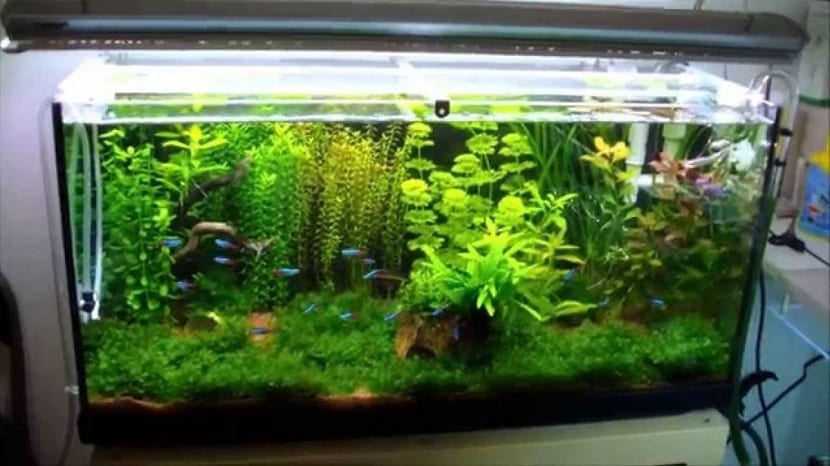
Lamps are essential for providing controlled lighting within the fish tank. In an aquarium, we must recreate conditions as similar as possible to the natural habitat of the fish and plants. To achieve this, certain elements are needed to recreate these conditions, especially in compact setups like nano aquariums , and to maintain a stable balance over time.
When many people start out in the world of aquariums, they often make the mistake of underestimating the role of lighting . They think that any light will do, but poor or poorly chosen lighting is one of the most frequent causes of stunted plant growth, uncontrolled algae blooms , and stressed fish. Achieving proper lighting is essential if we want to guarantee the best conditions for our fish and balanced plant growth.
Furthermore, the choice of lighting directly influences the overall aesthetics of the aquarium . Good lighting enhances the colors of the fish, highlights the textures of rocks and driftwood, and creates a very attractive sense of depth and volume. Today, aquarium lights with LED technology allow you to combine efficiency, a suitable spectrum, and different color temperatures to achieve spectacular results, all with reduced energy consumption.
Each aquarium is unique, and the lighting for each one depends on the ecosystem being recreated and its specific characteristics. Some of the variables we must consider are:
- Aquarium size and depthA deep tank needs more intensity and better light penetration.
- Species de pecesSome prefer dim light and shaded areas, while others look better in bright light.
- Presence of natural or artificial plantsReal plants need a minimum level of light to survive and develop.
- Mounting type: planted aquarium, simple community aquarium, aquascaping, marine aquarium, shrimp tank, nano aquarium, etc.
- Desired aesthetic: warmer tones, neutral white light, bluish hues or RGB effects.
The lighting should be appropriate for the tank size to recreate the necessary amount of light for the ecosystem. If we rely solely on natural light for our aquarium, it's very difficult to control its intensity and duration, and excessive algae growth is common . Therefore, it's advisable to use artificial light as the primary source and avoid direct sunlight on the glass.
A biological rhythm with light and dark periods of between 8 and 12 hours should be provided in most cases. Turning on the lights beyond this range offers no real benefit to plants or fish and will only increase the risk of algae and waste energy. If you have very demanding live plants, you can increase the lamp's intensity or choose a more powerful model, but excessively extending the number of hours of light is not recommended.
Aquarium lamp lighting technology

Historically, fluorescent tubes have been the primary lighting fixtures used for aquariums . This was due to their affordability , the wide variety of models available, and their good performance relative to their lifespan. However, technological advancements have broadened the range of options, and today we have much more efficient and versatile alternatives.
For a time, halogen and metal halide vapor (HQI) aquarium lamps were also popular . These offered very intense light, but they consumed a lot of energy , generated considerable heat in the aquarium, and increased water evaporation . Furthermore, the light spectrum was not always the most suitable for optimal plant growth.
Currently, the most efficient and recommended options are those that use LED technology specifically designed for aquariums . These lights and lamps have a much more compact and minimalist design, allow for better control of the light spectrum , offer great durability , and emit significantly less heat than older options. For this reason, the vast majority of aquarium enthusiasts and professionals opt for LED lights, both in beginner aquariums and in high-end setups.
To measure the effectiveness of aquarium lighting, several key variables are used , such as:
- The amount of light emitted by the light source, usually expressed in lumens or, in the case of plants and corals, also considering PAR (photosynthetically active radiation).
- Quality of the light spectrumThat is, the combination of wavelengths emitted by the lamp and its suitability to the needs of plants and fish.
- Lamp duration and life cyclewhich influences both the long-term cost and the stability of the lighting over time.
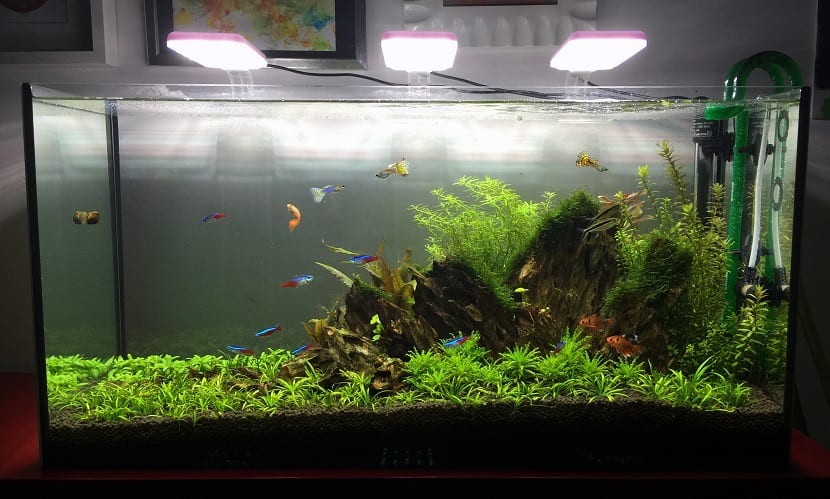
We can't just place lighting anywhere in the aquarium without considering its effect. The light fixture must provide the necessary light energy for the aquarium plants to develop properly, but it must also distribute it evenly to avoid very dark or excessively bright areas.
Furthermore, the position and orientation of the light have a significant impact on the aesthetic perception of the aquarium . If the light is positioned correctly, the observer will be able to better appreciate the rich colors of the fish, the texture of the substrate, and the details of rocks, driftwood, and plants.
By illuminating from the front, the aquarium light will fall on the fish and plants from the front and slightly from above. This allows the observer to better perceive the range of colors and reduces harsh shadows. In more elaborate setups, you can also play with lighting angles and color combinations to enhance volume and create more immersive underwater landscapes.
Modern LED lights often include advanced features such as dimming , RGB LED color changes , simulated sunrise and sunset, and even complete cycles that mimic the passage of time. These features are not only visually appealing but also help reduce stress in fish by preventing sudden changes in light, and allow you to tailor the lighting to the specific needs of each species and type of plant.

Choosing the best LED aquarium light involves considering the technology used , the size of the tank , the type of plants and fish you'll be keeping, the required intensity and spectrum , and any additional features that can simplify daily management, such as timers or remote control. With quality lighting that is properly sized and programmed, you can enjoy a healthy aquarium with thriving plants, active fish, and vibrant colors that will stand out spectacularly in any room of your home.
