

In today's article, we'll take an in-depth look at a marine species called the roosterfish . It's a fish known for its fighting strength and is quite appealing as a challenge for sport fishing. Because of its power, it's rather difficult to catch if you're not skilled with a rod. Therefore, as a way to test your skills, this fish is frequently caught. The name "roosterfish" is applied to different species depending on the country and context.
Besides its impressive strength and popularity as a fishing fish, this article will tell you all about its biology, characteristics, and behavior , as well as regional differences, fishing techniques, and information for responsible consumption. Want to learn more about the roosterfish? Just keep reading.
Key features

Like the oarfish , the roosterfish , a popular sport fish on the beaches of the eastern Pacific, has a long, muscular body that makes it perfect for targeting with surface lures. Large specimens can reach around 1,5 meters in length and weigh over 45–50 kg , with a very visible dorsal ridge formed by long rays that gives it its common name.
In the culinary traditions of the Northeast Atlantic and Mediterranean, the term "gallo" refers to several species of flatfish from the family Scophthalmidae , primarily Lepidorhombus boscii (sandfish) and Lepidorhombus whiffiagonis (northernfish). These fish have a thin, translucent, and flattened body , with both eyes located on the same side of the head (usually the left), a typical adaptation of flatfish.
In the Southern Cone of South America, "roosterfish" also refers to Callorhinchus callorynchus , a cartilaginous fish related to chimeras, with a fusiform body, slender tail, and silvery coloration with spots . It has a very distinctive proboscis or trunk on its snout . Males develop claspers (modified pelvic fins), a frontal tenacle , and prepelvic graspers covered with spiny scales, structures used to hold the female during mating.
In general, we can summarize some relevant diagnostic features by type as follows:
- Pacific roosterfish (Nematistius pectoralis): robust body, sail-shaped dorsal crest, blue-grey back with silver tones and dark lateral bands. Oblique mouth with small teeth; predator with great resistance to lure drag.
- Atlantic-Mediterranean flatfish (Lepidorhombus spp., family Scophthalmidae): flattened body, very fine and semi-transparent, eyes on the left side, sinuous lateral line clearly visible, discreet spots on the back; excellent for consumption for its white meat.
- Patagonian roosterfish (Callorhinchus callorynchus): cartilaginous fish with snout; scaleless skin over much of the body except for regions with placoid scales thorny; frontal tenaculum and handles prepelvics in males; silvery with large dark spots.
In all cases, the coloration usually includes bluish-gray and silver tones . In the roosterfish, the bands on the back towards the caudal peduncle and its dorsal "sail" make it unmistakable; in the flatfish, the skin shows blue-green iridescence on the back and whitish belly; and in Callorhinchus, the contrasting spots and the snout stand out.

Range and habitat
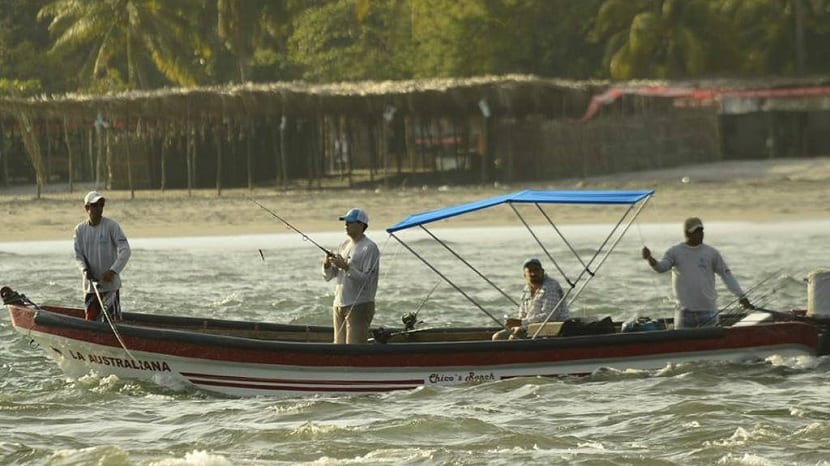
This species shares its habitat with the amberjack when we talk about the roosterfish of the eastern Pacific. It can usually be seen near the coast , around open beaches, estuaries, river mouths, and rocky shoals , where it hunts in surf and ledges. It always seeks to settle near reefs to take advantage of sheltered areas and hunting currents.
It has occasionally been found established at the ends of beaches, estuaries, and even coastal lagoons . When still juveniles, they can live in very shallow waters . The time of year when they are most frequently sighted and caught usually coincides with months of warm waters and calm seas , when coastal prey congregate.
In contrast, Atlantic-Mediterranean flatfish ( Lepidorhombus spp.) inhabit waters from shallow depths to over 400 m , and can even be found at 800 m in sandy and muddy bottoms of the continental shelf and upper slope. They are benthic fish that remain partially buried in the sand , lying in wait for their prey.
The Patagonian roosterfish ( Callorhinchus callorynchus ) is found on the continental shelf of southern South America, mainly from southern Brazil to Chile , with frequent sightings at depths of less than 200 m to 480 m . In spring and summer, coastal areas serve as spawning and nursery grounds , with a high presence of neonates and juveniles, while adults migrate to deeper waters at the end of summer.
Roosterfish feeding and reproduction
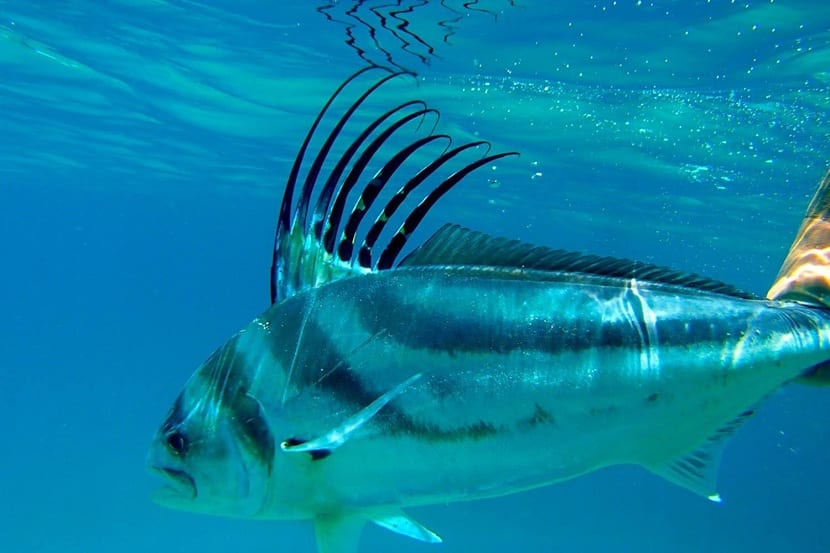
The Eastern Pacific roosterfish has great speed and maneuverability to pursue prey in surf. Thanks to its hunting skill, can feed on a wide variety de peces of different sizes, as well as cephalopods and crustaceans. In periods of scarcity, it can intensify the trophic opportunism on schools of sardines or anchovies, to which persistently harasses until you catch them.
Flatfish ( Lepidorhombus spp.) are benthic predators that consume crustaceans, cephalopods, and small fish . They have dentition adapted for crushing thin-shelled prey, with differences according to size and sex as their feeding habits change.
The Patagonian roosterfish ( Callorhinchus callorynchus ) is a benthic feeder , consuming bivalves (such as scallops), gastropods, polychaetes, crustaceans, sea urchins, and fish . Its powerful teeth allow it to grind its prey efficiently.
Regarding reproduction , it is important to distinguish:
- Roosterfish (Pacific): like most de peces coastal marine bones, fertilization is externalThe laying would take place in shallow waters near the coast, and the larvae/fry remain close to the surface until they grow larger and move to slightly deeper areas. Juveniles use bays and estuaries as breeding areas.
- Flatfish (Atlantic–Mediterranean): oviparous with external fertilization. They perform staging sandy bottoms in different annual periods depending on the area. The juveniles occupy coastal waters and they gain depth with growth.
- Callorhinchus callorynchus: oviparous with internal fertilizationThe female releases two simultaneous ovicapsules, up to 27 cm, greenish-yellow color that darkens to black. The capsules show a smooth central part and a filamentous edge, and can reach the coastline after stormsIn Patagonian regions they have been described two spawning peaks coastal throughout the year, with a high proportion of females with spermatophores in midsummer. It presents sexual dimorphism marking: females reach larger sizes and weights than males.
Regarding growth and longevity , records from the Argentine Sea cite female Callorhinchus living up to 17 years and males up to 10 years . Sexual maturity is reached later in females than in males, with mature sizes around 42 cm and 38 cm respectively, and approximate maximum sizes of 70 cm and 61 cm . This species exhibits multi-year reproductive cycles.

Roosterfish sport fishing
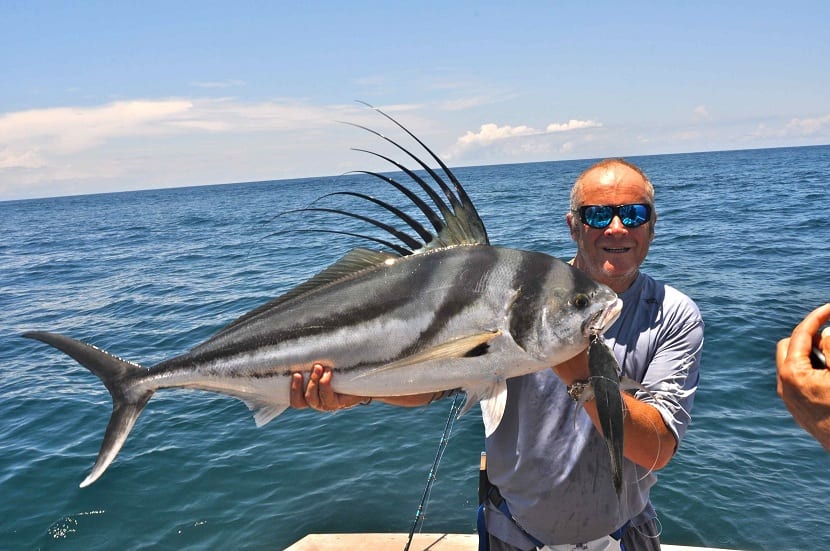
These fish are very popular in the world of sport fishing. What anglers seek most is the technical challenge that tests their skill. In the case of roosterfish, the most productive season usually coincides with warm, stable periods outside of the local breeding peak.
For roosterfish on the eastern Pacific coast, surface lure fishing is iconic:
- Lures: poppers and stickbaits of good size, alternating with live bait when searching large specimens.
- Keys to the throw: throw far offers time to “turn on” the fish with animation; you will see the dorsal ridge break the surface following the decoy before the attack.
- The fight: sustained and strategic; alternating long races with false surrenders before another onslaught. Progressive braking and consistency are crucial.
For recreational coastal fishing of the Patagonian roosterfish, many enthusiasts use surfcasting equipment adapted to the controlled drift of the tackle over the bottom:
- White hair between 3,5 and 4,2 m capable of launching weights of up to 250 gr; front or rotating reels with over 200 m of 0,28–0,35 mm nylon and conical whip of 10 m.
- Hooks medium/small (e.g., 1/0–3/0) in arm lengths of at least 50 cm, tied with strong nylon (≈0,70). The fish's mouth is not large in proportion to its body; Small hooks improve hook setting.
- Mounts: from one to three hooks; the more hooks, shorter casting distance. Alternate fishing anchored with controlled drift (letting the lead work with the current) to cover ground and give the fish time to take the bait.
- baits: prawn, magrú, anchovy, silverside or squid, alone or in combination; embody generous and fix with elastic thread leaving the point of the hook exposed.
- Reading the tide: the current “carries” the smell of the bait; with high tide or full low tide (zero drift) activity usually falls. It compensates releasing line and adjusting the weight and type of lead.
Commercial fishing for the meat of the flatfish is done by trawling at depths of 100 to 500 meters , and also by longlining . Its commercialization increased as it became popular for sport fishing and as a culinary delicacy. The smallest specimens caught are 25 cm , although in some countries it is prohibited to catch flatfish smaller than 20 cm . It is important that the areas where flatfish fishing is most prevalent are prepared to reduce the environmental impact.
The areas corresponding to the North Atlantic are those where enormous specimens of flatfish, exceeding one meter in length, have been caught, while in the Mediterranean, the average sizes are smaller. The areas with the highest commercial catches include the Gulf of Cádiz, the Cantabrian Sea, and the Northwest of the Iberian Peninsula. The problem with trawling is the capture of non-target species and the damage to seabeds, including seagrass meadows and algae.
Nutritional properties and responsible consumption
The commercially available "blond" (primarily Lepidorhombus spp.) in European fish markets is a lean white fish with very few bones and a fine texture. Per 100g, it provides approximately 80 kcal , with 15,8g of protein , 1,9g of fat (of which 0,3g are saturated), less than 0,5g of carbohydrates and fiber, and an interesting profile of B vitamins (B3, B6, B9, B12) and minerals such as phosphorus, potassium, selenium, magnesium, iodine, and iron . It is a well-regarded option in nutritional labeling systems due to its balanced profile and low fat content.
In cooking, it allows for simple and healthy techniques:
- Baked in papillote with vegetables and butter style miller: enhances its mild flavor and maintains juiciness.
- Fried Andalusian style Lightly coated in flour: crispy on the outside and juicy on the inside; ideal with salad or potatoes.
For responsible consumption , learn about fishing gear, local minimum size limits, and origin; prioritize low-impact catches and respect closed seasons and breeding periods. In the case of Callorhinchus callorynchus , various regional assessments list it as Vulnerable , so the management of its recreational and commercial harvesting must be especially careful.
Quick guide to identification by region
To avoid confusion when talking about "roosterfish", use these keys:
- Eastern Pacific (Mexico to Peru/Galapagos): “roosterfish” is the roosterfish (Nematistius pectoralis), high dorsal crest, side stripes, fishing with poppers and stickbaits on beaches and shallows.
- NE Atlantic and Mediterranean: “rooster” are flatfish, mainly Lepidorhombus boscii y L. whiffiagonis, White meat, benthic habitat in sandy bottoms of platform and slope.
- Southern Cone (SW Atlantic): “roosterfish” refers to Callorhinchus callorynchus, cartilaginous fish with trunk, tenaculum and handles; oviparous with ovicapsules.
With this clarification, you will be able to correctly interpret data on size, habitat, reproduction and fishing gear according to the geographical context, and thus better plan your outings or your purchases at the fishmonger.
Thanks to its agile movements, the Pacific roosterfish can be found in places like river mouths, rocky cliffs, and areas with strong waves . And, as with most demersal fish in the Atlantic and Patagonia, flatfish and Callorhinchus prefer sandy bottoms , moving seasonally between coastal breeding areas and deeper waters.
Beyond these differences, all the "roosters" share an inspiring trait: they are species that reward the attention to detail of the fisherman or the cook, and that invite fishing and consuming with knowledge and respect for the sea.
