
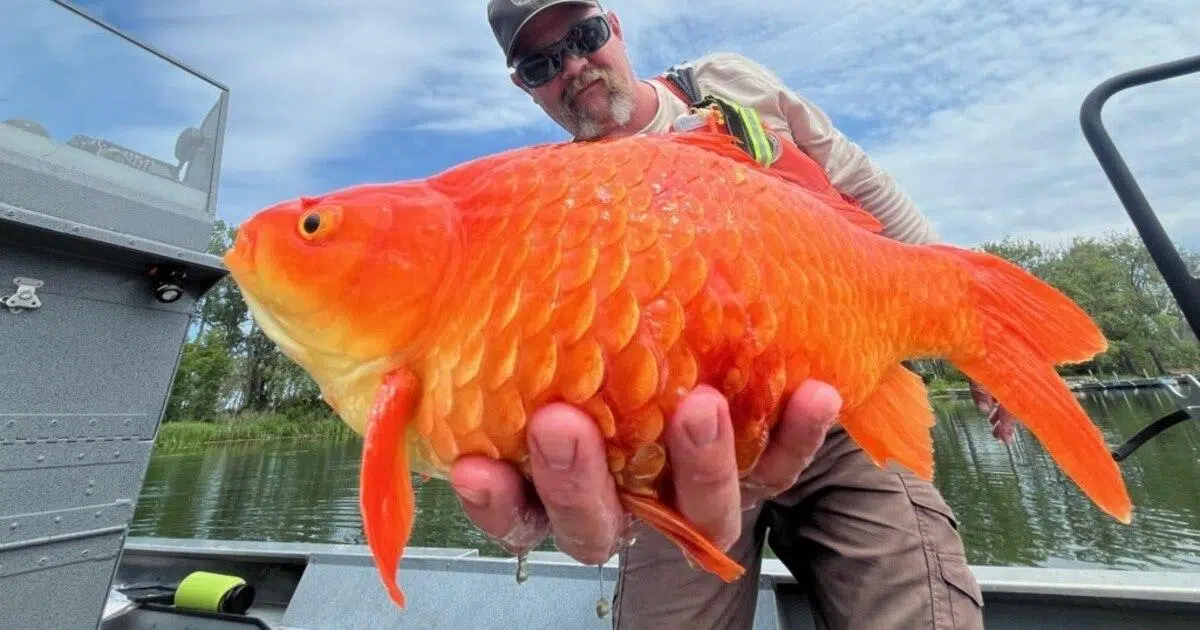
Goldfish, those animals we associate with children's aquariums, good luck, and "easy" pets , have become one of the clearest examples of how a domesticated species can unleash a very serious environmental problem. What begins as a small fish in a glass tank can end up being a veritable "Megalodon" weighing almost two kilos in a lake—a case of giant fish, a growing threat to ecosystems , completely disrupting their balance.
Behind that innocent appearance lies an explosive combination of high adaptability, voracious appetite, resilience, and rapid reproduction . Added to this is another, less visible threat: pollution from plastics and their additives, such as the phthalate DEHP, which affects the physiology and behavior of goldfish and has cascading implications for aquatic ecosystems. Understanding all these factors is key to knowing why goldfish are destroying ecosystems in different parts of the world.
Origin of the goldfish and how it went from pet to invasive species

The goldfish ( Carassius auratus ) is a freshwater carp native to Asia, domesticated in China over a thousand years ago. Over the centuries, it has been selectively bred for its orange and reddish coloration, relative ease of breeding, and hardiness , becoming one of the most popular aquatic pets in the world.
Today it is part of the family of Cyprinids (Cyprinidae)The group de peces The goldfish is the most farmed freshwater fish in the world. Besides being ubiquitous in home aquariums and ornamental ponds, it is commonly used in scientific investigationprecisely because of its resistance and ease of handling in the laboratory.
Its popularity is culturally reinforced: it appears in classic films and children's series such as "Pinocchio," "Chicken Little," and "Peppa Pig," where it is presented as the perfect pet for children. This endearing image contrasts sharply with the impact it can have when released into real rivers, lakes, or wetlands.
The problem begins when well-intentioned owners, who can no longer care for their fish, decide that the best thing to do is "return it to the wild ." They release it into a park pond, a nearby river, or a lake, convinced that the animal "will be happy" that way. Without technical supervision, this seemingly compassionate gesture becomes the source of very harmful invasive populations.
How goldfish transform ecosystems
Once released into the wild with ample space and food, goldfish are no longer limited by the size of their tank and controlled feeding. Their remarkable phenotypic plasticity allows them to adapt their size to the available resources: with enough food and a spacious habitat, they can grow much larger than most people imagine.
In natural environments, specimens have been found the size of a soccer ball or a dinner plate , reaching weights of around 1,8-2 kilos, comparable to a medium-sized Chihuahua. This disproportionate size, combined with its voracious appetite, multiplies its impact on native species.
Their diet is key to understanding why they are so problematic. Goldfish are omnivores with a strong carnivorous tendencyThey consume eggs and larvae de peces native species, as well as juvenile individuals of other species, are introduced. This reduces the number of new generations of local fauna and weakens native populations, which also tend to have less capacity to respond.
When feeding, they employ a "stirring up the bottom" technique: they dig and stir up the sediment in the seabed to find food. This behavior has two serious effects: on the one hand, it clouds the water by suspending mud and particles; on the other, it releases buried nutrients, which promotes explosive algae growth.
This proliferation of algae, especially harmful algae, worsens water quality, reduces light penetration, and, as the algae die and decompose, consumes much of the dissolved oxygen . The result can be the death of other fish, invertebrates, and aquatic plants, and a drastic change in the ecosystem's structure.
In addition to all this, goldfish can act as carriers of diseases and parasites unknown to local species. Like other carp, they can introduce pathogens that native populations have never encountered, increasing the risk of outbreaks and mass die-offs.
Real-life cases: from “Megalodon” in Pennsylvania to plagues in Canada and Australia
Environmental authorities in various countries have documented cases that seem like something out of a science fiction movie, but are entirely real. In Lake Erie, Pennsylvania, the U.S. Fish and Wildlife Service (USFWS) captured a dorado weighing approximately 1,8 kilograms , which they ironically nicknamed "Megalodon."
The Service itself explained on social media that the fish “shouldn’t be there,” and that someone released it thinking they were doing it a favor. They emphasized that releasing it had created a potentially invasive problem for decades , and issued a very clear message: if you can’t keep your fish, find another way to rehome it, but “just don’t release it.”
This is not an isolated incident. In Minnesota, the city of Burnsville issued a warning after finding large concentrations of [unspecified substance]. de peces golden dorado in local lakes, such as Big Woods Lake, where they were withdrawn between 30.000 and 50.000 copies in a single dayThey emphasized that these fish grow quickly, reproduce rapidly, and degrade water quality. They destroy habitats and native species.
In Canada, specifically in the province of Alberta, authorities have detected goldfish "the size of a dinner plate," according to an invasive species specialist from Parks and Ecosystems. They have been found in cold, low-oxygen waters that are difficult for many species , where these fish, without natural predators, thrive unchecked.
The expert estimated that there were already “hundreds or thousands” de peces golden fish in rivers and bodies of water, and pointed out a key issue: many people release them convinced that it is a humanitarian act, when in reality they are causing a serious environmental problemIn Canada, in fact, it is illegal to transfer fish from one body of water to another without authorization.
The phenomenon is not limited to North America. In Australia, 15 goldfish were tracked for a year in a field study, which found they could migrate from urban canals to rivers and large wetland systems , where they reproduce. Migrations of more than 230 kilometers were documented in a single year, an impressive capacity for expansion for a species that many still see as "just a fishbowl fish."
An invader with an insatiable appetite: scientific evidence
Science has begun to quantify in greater detail why goldfish are such a dangerous and invasive species. Researchers at Queen's University Belfast compared the ecological impact of two popular aquarium fish species in Northern Ireland: the common goldfish (Carassius auratus) and the white cloud mountain minnow (Tanichthys albonubes), both members of the Cyprinidae family.
The study, published in the journal NeoBiota, concluded that goldfish consume significantly more resources than other comparable fish in UK waters. They eat more than other invasive species analyzed and are better equipped to compete with other species, giving them a consistent advantage over native fauna.
Lead author Dr. James Dickey described goldfish as animals that combine “insatiable appetites” with bold behavior . This mix of voracity and audacity makes them particularly effective invaders, especially in ecosystems where local species are not adapted to such pressure.
The study also highlights that the climate of northern Europe , which in theory could act as a barrier for many exotic species, is not a deterrent for the goldfish. These fish tolerate cold waters, temperature variations, and harsh conditions well, allowing them to establish themselves and expand in rivers and lakes where they were previously thought not to survive.
The researchers' conclusion is unequivocal: goldfish are a high-risk species . They propose restricting their availability in the trade, at least in certain regions or under certain conditions, and combining this restriction with better education for owners and hobbyists to reduce irresponsible releases.
Plastic pollution and the effects of DEHP on goldfish
The ecological damage associated with the goldfish is not limited to its role as an invasive species. It is also playing a key role in research on the effects of plastic pollutants on aquatic ecosystems. A clear example is the study by the Complutense University of Madrid (UCM) on the impact of the plasticizer di(2-ethylhexyl) phthalate (DEHP) on this species.
The DEHP is a phthalate widely used in industrial and domestic plastics to provide flexibility and durability. Over time, these plastics degrade and release the additive into the environment, reaching rivers, lakes, and reservoirs. The “Neuroendocrinology” research group de pecesThe UCM exposed goldfish (Carassius auratus) to DEHP for 14 days to evaluate physiological and behavioral effects.
They observed that DEHP produced an imbalance in the neuroendocrine signals that regulate hunger , clearly reducing food intake in the fish. However, despite eating less, the fish did not lose weight or stop growing. The reason? They compensated for the reduced intake by lowering their energy expenditure : they moved less and exhibited a lower metabolic rate.
This energy adjustment comes at a cost in terms of well-being and behavior. Fish treated with DEHP showed increased signs of anxiety , measured using place preference tests, where they could choose between areas considered “safe” and other open or brighter areas, perceived as “aversive.” The increase in anxious behaviors suggests a negative impact on their emotional state and how they interact with their environment.
To understand the mechanisms involved, scientists studied whether DEHP altered signals related to the regulation of food intake and anxiety in the brain and liver . The work, published in Comparative Biochemistry and Physiology Part A: Molecular & Integrative Physiology, pointed to the involvement of signaling through PPARs and neuroendocrine peptides linked to appetite and stress.
According to researcher Nuria de Pedro, these results are very useful for environmental management, sustainable aquaculture, and chemical risk assessment . They allow for the detection of sublethal and chronic effects in species of ecological and economic interest and reinforce the need for strict regulation of phthalate use in everyday products.
The next step for the UCM group is to analyze separately the effects of “pure” microplastics and those containing DEHP , to better distinguish what part of the toxicity is due to the polymer itself and what part to the additive. The goldfish, due to its widespread use in laboratories and its massive presence in aquariums, has thus become a key model for evaluating the impact of plastic pollution on aquatic fauna.
Extreme resilience, long migrations, and rampant reproduction
Besides its voracious appetite, the goldfish has a number of biological characteristics that facilitate its successful invasion. After centuries of coexistence with humans, its organism is able to "recover" wild traits when released into the wild: greater resistance, the ability to withstand waters with low oxygen levels, and adaptability to a wide range of temperatures.
In the wild, they can withstand harsh conditions that would be lethal to other fish: cold, eutrophic waters with significant oxygen fluctuations. This hardiness gives them a hugely unfair competitive advantage over many more delicate native species.
Field studies, such as the one conducted in Australia, confirm that they not only survive, but also travel great distances . Their ability to cover more than 230 kilometers in a year allows them to colonize entire river networks: from canals where their owners release them to major rivers and extensive wetland systems.
In addition to this, they have an enormous reproductive capacity. Goldfish produce large quantities of eggs in each spawning and can reproduce repeatedly throughout their lives. Colloquially, some experts say they "reproduce like rabbits," alluding to their speed and abundance of offspring.
In home aquariums, limited space, water quality, and human control restrict reproduction and growth to some extent. But once released into a natural environment with fewer limitations, all that explosive potential unfolds : they grow much larger, disperse, reproduce, and overwhelm the capacity of those managing the environment.
Economic impact of biological invasions and the role of the goldfish
Biological invasions are not only an ecological problem; they also have a direct impact on the economy. Invasive alien species force the expenditure of large sums of money on control, eradication, and ecosystem restoration, in addition to causing losses in fishing, tourism, agriculture, and other sectors.
An estimate from the National School of Higher Studies (ENES) in Mérida, part of the National Autonomous University of Mexico (UNAM), calculated that between 1970 and 2017, nations worldwide spent $1.288 trillion to address the costs associated with invasive species. The analysis also suggests that these costs triple every decade.
Although some countries, such as Mexico, lack specific official figures on the impact of goldfish, data from the United States indicates damages of around $120.000 billion annually caused by invasive organisms in general. Within this context, the goldfish has become a prime example of how an inexpensive pet can trigger millions of dollars in expenses and long-term ecological damage.
In areas like the Great Lakes of North America, authorities have been warning for years about the proliferation de peces golden and its ability to establish itself in almost every state in the country, with the possible exception of Alaska. Its rapid expansion is explained by a combination of adaptability, lack of natural predators, and a constant influx of specimens released from home aquariums.
What not to do with your goldfish and responsible alternatives
Part of the problem stems from misinformation about what to do when we can no longer care for the fish. Some people choose to flush it down the toilet , thinking that this gives it a chance at life "in the wild" or that it's the least cruel way to get rid of it. Others take it to a nearby pond, river, or marsh so that "it can live better."
Authorities and biodiversity experts are adamant: goldfish should not be released into any natural ecosystem , not in urban lakes, rivers, reservoirs, or, least of all, protected areas. An act perceived as compassionate could lead to the creation of an ecological "monster," an enormous fish with a devastating impact on local species.
It's also not a good idea to empty the fish tank water into rivers, lakes, or sewers connected to the natural environment. That water may contain diseases, parasites, and traces of medications that pose a risk to native fish and other aquatic organisms.
So what are the options? Organizations like the U.S. Fish and Wildlife Service recommend putting the fish up for adoption , either through pet stores, aquarium societies, online forums, or social media for hobbyists. Often, there are people with large aquariums or controlled ponds who can take it in.
It is also suggested to contact veterinarians or aquatic wildlife specialists for advice. In some cases, when relocation is not a realistic possibility, humane euthanasia is considered, following technical criteria (for example, in some countries the option of controlled euthanasia by freezing has been mentioned, always carried out properly and under supervision, although this point generates ethical debate and must comply with local regulations).
In countries like Canada, the regulations go even further: it's illegal to move fish from one body of water to another without a permit. Owners are encouraged to return the fish to the store if possible, donate it to schools with aquariums, or seek professional help for a responsible solution. The message is clear: however tempting it may seem, "releasing" them is not an act of kindness, but rather a source of problems for decades to come.
Taken together, the story of the goldfish shows that a seemingly harmless pet can, if mismanaged, become a far-reaching agent of ecological and health change . From the effects of DEHP on its physiology to its ability to colonize entire rivers, and including the associated economic costs, everything points to the same conclusion: responsible management of aquatic pets and regulation of trade and pollutants are key to preventing more ecosystems from falling prey to these invasive "goldfish."

Table of Contents
- 1 Origin of the goldfish and how it went from pet to invasive species
- 2 How goldfish transform ecosystems
- 3 Real-life cases: from “Megalodon” in Pennsylvania to plagues in Canada and Australia
- 4 An invader with an insatiable appetite: scientific evidence
- 5 Plastic pollution and the effects of DEHP on goldfish
- 6 Extreme resilience, long migrations, and rampant reproduction
- 7 Economic impact of biological invasions and the role of the goldfish
- 8 What not to do with your goldfish and responsible alternatives