

In the world of fish and aquariums, there are some truly spectacular species due to their vibrant colors and unique fins. These fish, with their wide variety of shapes and unique characteristics, are well worth discovering.
In this case, we're talking about the betta fish . A fish well-known for its bright and vibrant colors, famous for being Siamese fighting fish, and for the aggression the male displays towards other bettas. Furthermore, it's a very popular species for both beginner and advanced aquarists due to its hardiness, adaptability, and curious and intelligent nature; it's even capable of recognizing its keeper and learning simple tricks if properly stimulated.

They are also known as Siamese fighting fish , and although in the wild their colors are more muted and discreet, selective breeding in captivity has resulted in specimens with intense hues and spectacular combinations of reds, blues, greens, whites, blacks, or yellows, as well as tails of very diverse shapes. All of this, combined with their relative ease of care, has made them one of the most popular ornamental fish in the world.
Want to learn everything about these fish—their types, care, diet, diseases, compatibility, and breeding? Below you'll find an extremely comprehensive and up-to-date guide to help your betta live a healthy, vibrant life for as long as possible.
Origin of the betta fish

The betta fish originated in Southeast Asia. They inhabit shallow, slow-moving waters in countries such as Thailand, Cambodia, Vietnam, Laos, Malaysia, and Indonesia. They are common in rice paddies, drainage ditches, ponds, marshes, and small pools formed in the region's warm floodplains.
These natural environments frequently suffer from intense storms, floods, and droughts . In response, the betta has developed incredible adaptation mechanisms that allow it to survive in very low-oxygen water conditions and with significant variations in water level and quality. This explains why it is such a resilient fish in aquariums, but also why it is essential to fully understand its needs in order to provide it with a suitable environment.
In their natural habitat, wild bettas are typically greenish-brown or olive in color , quite dull compared to aquarium specimens. This coloration helps them camouflage themselves among leaves and roots , protecting them from predators. Their fins are also shorter, as very long tails would be a hindrance in waters with dense vegetation.
Through selective breeding in captivity, breeders have reinforced specimens with more intense colors and exaggerated fins, resulting in the striking varieties we see today in pet stores and home aquariums. It's important to understand that these aquarium fish are much more delicate than wild bettas when it comes to their fins, as they are easily damaged by strong currents or sharp decorations.
The labyrinth organ and its ability to breathe air
One of the key characteristics that the betta has developed to adapt to extreme environments is the presence of a special respiratory organ called the labyrinth . This organ, located above the gills, allows it to take oxygen directly from the atmospheric air.
Thanks to their labyrinth organ, bettas can survive in very oxygen-poor waters, such as nearly stagnant ponds, very shallow rice paddies, or small, isolated pools. If they find themselves in a place with little water, as long as the fish's body remains moist, it can rise to the surface and gulp air to obtain the oxygen it needs.
It's important to note that this ability doesn't mean the fish can live healthily in extreme conditions for extended periods, but rather that it helps it survive temporarily in critical situations. Therefore, although a betta can tolerate poor water conditions, if we want it to live for several years and display its best colors, we must provide it with a well-maintained aquarium, sufficient space, and stable water parameters.
In captivity, although they can survive in small spaces without filtration, they thrive much better in larger aquariums with warm, stable, and well-maintained water . The most suitable temperature for their growth and development is generally between 24 and 27 degrees Celsius , although many experienced keepers comfortably maintain them between 25 and 28 degrees, always ensuring stability.
Why is it called betta?
There is a widely accepted theory that the name of this species comes from an ancient warrior clan known as the "Bettah" in the region. These fish, as mentioned, are very territorial and excellent fighters, especially the males. For this reason, they became known as Siamese fighting fish , referring to their country of origin (ancient Siam, present-day Thailand) and their combative nature.
In the past, it was common in some parts of Asia to organize fights de peces betta in small containers. These fights became a popular form of entertainment, where bets were placed. The practice was so common that the authorities of the time even legally regulate fightsDuring these encounters, the fish's resilience and courage were valued more than the damage inflicted on the opponent.
Today, the responsible aquarist community rejects these practices, and promotes the betta as an ornamental pet , valuing its curious nature and beauty, not its aggressiveness.
Bettas' favorite food
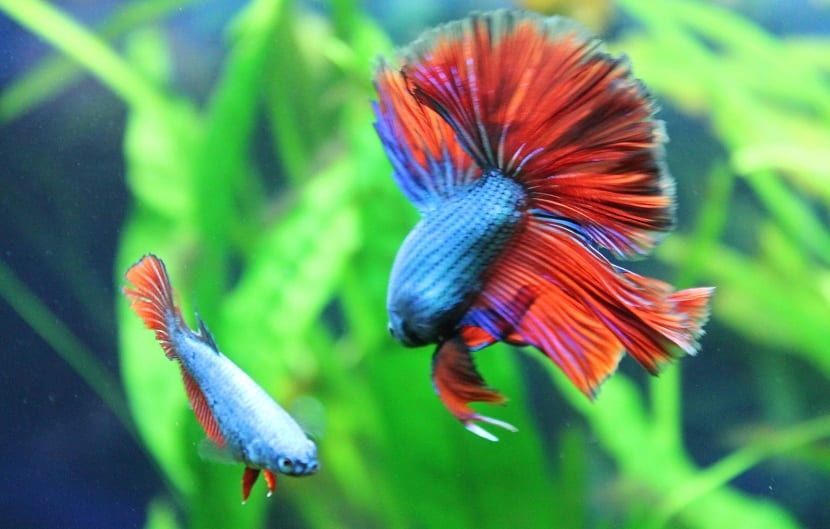
Bettas have an upward-facing , slightly inverted mouth, indicating that they feed primarily in the upper part of the water column. In the wild, they are carnivorous with an insectivorous tendency , consuming mosquito larvae, insects that fall into the water (flies, small crickets, mosquitoes), small crustaceans, and other small prey.
In aquariums, they readily approach the surface to feed, as they are accustomed to surfacing for air. Foods that best suit their diet include dried or frozen bloodworms (red mosquito larvae), brine shrimp (artemia), and daphnia (water fleas). These foods closely mimic the betta fish's natural diet and provide high-quality protein.
Commercial foods specifically formulated for bettas are highly recommended because they combine animal-based ingredients with vitamins, minerals, and other essential nutrients. This formulation contributes to more vibrant coloration , improves disease resistance, and extends the fish's lifespan.
In addition to specific dry foods (pellets or flakes specially formulated for bettas), it's a good idea to regularly offer live or frozen foods such as brine shrimp, daphnia, mosquito larvae, or grindal worms. These live foods stimulate their hunting instincts, improve muscle development, and provide a more natural texture. However, it's best not to base their entire diet on a single live food (for example, only bloodworms) because these can be relatively poor or unbalanced in certain amino acids.
There is a widespread myth that bettas can feed on the roots of plants, such as peace lilies or other species grown in the vases where they are kept. This is completely false: bettas cannot survive on a diet consisting solely of roots or plant matter . They need a diet rich in animal protein and adequate fiber, so a diet based only on plants would cause severe malnutrition.
Frequency and amount of food
To keep a betta fish healthy, it's essential to control the amount of food offered. They have a voracious appetite, and it's easy to overfeed them. Ideally, they should be fed once or twice a day , with small portions that they can consume completely in less than 2-3 minutes.
As a general guideline, for betta-specific pellets, two or three medium-sized pellets per feeding are usually sufficient, adjusting according to the size of the fish and the type of food. If frozen or live foods are being fed, one or two small portions per feeding are usually enough. If the fish leaves food uneaten after a few minutes, it's a sign that it has been given more than necessary.
It is also advisable to periodically incorporate short fasting days (for example, one day a week without food) to help cleanse your fish's digestive system and prevent constipation or fatty liver. A healthy betta can easily withstand several days without food, provided the fast is not excessively prolonged.
Recommended foods to avoid
Among the most recommended foods for a betta are:
- Specific pellets for betta, formulated with a high content of animal protein.
- Live or frozen foods such as brine shrimp, daphnia, mosquito larvae and bloodworms (as a supplement, not the only food).
- Freeze-dried foods (for example, artemia or dried bloodworms) as an occasional supplement, always hydrating them beforehand and alternating them with other foods.
And among the foods that should be avoided or used in very small quantities:
- Generic tropical fish food not specifically for bettas, with too much cereal or vegetable flour.
- Exclusively plant-based foods, such as those designed for herbivorous fish, which They do not meet their protein needs.
- Human food remains, bread, cookies, or other food that may quickly pollute the water and make the fish sick.
PREMIUM QUALITY de peces betta and tail forms
There are numerous types de peces betta. It's about different phenotypes of the same species, Betta splendens, obtained from selective breeding by breeders. In addition to color patterns, one of the most variable characteristics is the shape of the tail and fins, which has led to a wide variety of trade names.
Some of the most well-known tail shapes are:
- VeiltailThe most common variety found in stores. It has a long tail that falls to one side like a veil. It is one of the hardiest and most widespread varieties.
- HalfmoonThe tail forms an angle close to 180 degrees when the fish opens completely, creating a perfect semicircle reminiscent of a crescent moon.
- Delta and Super Delta: triangular tails that open at a smaller (delta) or close (super delta) angle to 180 degrees, but without reaching the full fan of the crescent moon.
- CrowntailThe fins show fine extensions on the rays, giving a "crown" or spike-like appearance around the tail.
- Poster: bettas of short finThey are more similar to wild bettas. They tend to be more active, resilient, and tireless swimmers.
- Double tailThey have a tail divided into two well-differentiated lobes, with a wider dorsal fin.
- Rose tail: a variety derived from the halfmoon, with fins so curled and overlapping that they resemble the petals of a rose.
Regarding coloration, a wide variety of lines have been developed: solids (a single dominant color), bicolors, marbles (irregular markings), koi (patterns reminiscent of koi), dragon (thick, pearly scales), copper, mustard, etc. Among these varieties, some of the most prized types are:
- The crown betta fish: This is a modification in which its tail and fins have slits between the rays, resembling the shape of the peaks of a crown.
- Betta cooper fishIt is characterized by its metallic tones dark that reflect light with coppery tones, hence their name (cooper/copper).
- The dragon betta fish: stands out for its thick, pearly scales, usually white or silver, which create a very striking contrast with the background color of the body.
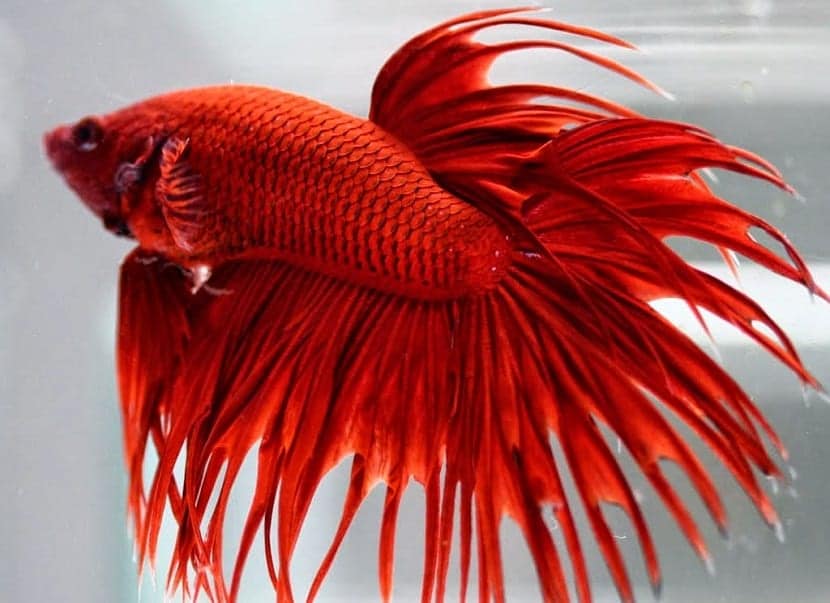
Crown betta fish
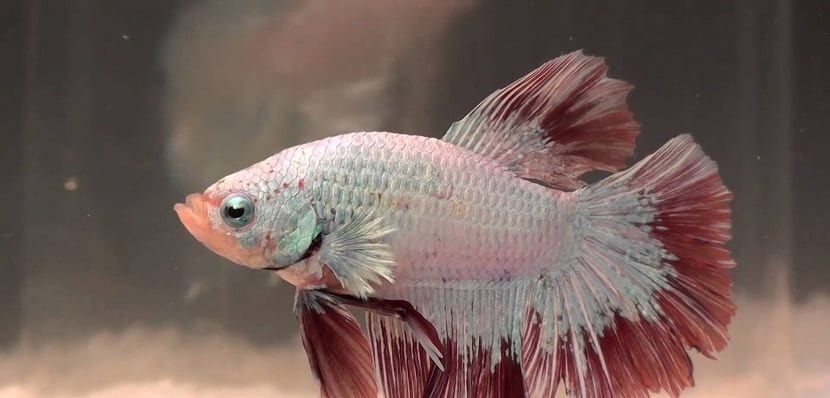
Dragon betta fish
Some breeders are developing fish that combine several characteristics in a single specimen, so there are already black copper dragon or red copper dragon fish , where metallic colors, dragon-type scales and bicolor patterns are combined.

Betta Black Cooper Fish
In addition to these, there are dozens of recognized varieties based on color, tail shape, and patterns, easily exceeding 70 distinct combinations. This makes the betta a particularly attractive species for hobbyists who enjoy morphological diversity.
Reproduction of betta fish

Breeding betta fish is one of the most fascinating processes in aquariums, but also one that requires the most planning, space, and experience . The male is primarily responsible for building and maintaining the bubble nest , where the eggs will be laid and develop.
To breed bettas at home, it's recommended to use a dedicated breeding tank , free of other fish, with shallow water (around 15-20 cm), a stable temperature, and suitable surfaces for nesting. Adding aquarium moss or floating plants where the male can build the nest can be very helpful. A plastic cup or a piece of floating cork can also be used as a support.
Before introducing them, the male and female should get to know each other without direct contact. Ideally, the aquarium should be divided by a glass or transparent plastic partition so they can see each other, display each other, and become accustomed to one another. If the female is introduced directly into the male's territory without this introduction phase, the male is very likely to consider her an intruder and attack her.
When the male begins actively building the bubble nest on the surface and the female shows signs of receptivity (vertical barring on her body, a slightly bulging belly, and an approaching posture towards the male), it will be time to pair them. The male will take a little while to initiate active courtship, spreading his fins and circling the female. Finally, he will grasp her by wrapping his body around her in a characteristic "embrace," during which the female will release the eggs and the male the sperm.
The eggs fall slowly, and the male collects them with his mouth, carefully placing them in the bubble nest. This process is repeated several times until the female runs out of eggs. Once spawning is complete, it is crucial to remove the female and return her to her aquarium, as the male may become aggressive towards her while focused on defending the nest.
The male will guard the nest, repairing the air bubbles and repositioning any eggs that fall out. Hatching usually occurs within 24 to 48 hours , depending on the temperature. After hatching, the chicks will remain hanging from the nest for a few days, feeding on their yolk sac. During this time, the male may continue to collect them and return them to the nest if they fall out.
Once the fry begin to swim freely , many breeders recommend removing the male as well to prevent him from eating them. From that point on, it will be essential to offer them very small foods , such as infusoria, microworms, or newly hatched brine shrimp nauplii, and to perform frequent, gentle water changes to maintain water quality without stressing the young fish.
What aquarium conditions are best for bettas?

Bettas are highly territorial fish. Regardless of sex, they can exhibit aggressive behavior towards other bettas, especially if they are two males. However, they are also curious and relatively peaceful fish with other suitable species in the right environment.
Regarding aquarium setup, bettas prefer well-planted spaces with shaded areas and hiding places . Underwater caves, driftwood, and dense plant clumps work very well to make a betta feel safe and reduce its stress level. A bare environment, without shelters, can lead to nervous behavior and dull coloration.
Regarding water, although the betta tolerates a wide range, it is recommended to maintain:
- TemperatureIdeally between 24 and 27 ºC approximately, avoiding dropping below 22 ºC and rising for a prolonged period above 30 ºC.
- pH: slightly acidic to neutral, around 6,0 – 7,5, although they can adapt to somewhat higher values if they are stable.
- HardnessModerate, with soft to medium-hard water, avoiding sudden changes.
To maintain water quality, it is recommended to change approximately one-third of the volume each time a water change is performed, refilling with fresh, pre-treated water at the same temperature. This allows the fish to gradually acclimate to changes in pH and hardness without experiencing stress.
In small tanks, water changes are recommended every three to four days , while in larger, filtered aquariums, they can be spaced out to once a week , depending on the biological load and the filter's efficiency. It is essential to avoid using soaps or disinfectants to clean decorations, as their residues can be highly toxic. It is best to use warm water and, if necessary, a soft brush to remove algae and debris.
Signs that your betta fish is healthy
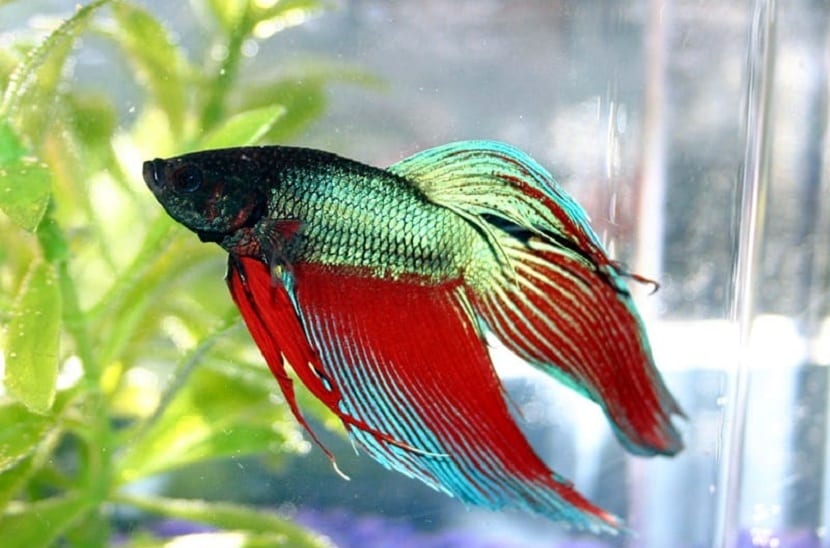
When we have betta fish in our aquarium, we should observe a series of indicators that will help us assess whether their health is good. A healthy betta is usually active, curious, and alert , moving around the aquarium, exploring objects, and reacting to the presence of its keeper.
Other positive signs of health include:
- Regular appetiteThe fish eats eagerly at each feeding and quickly approaches when it detects food.
- Fins deployed: the fins are shown open, without fraying or continuous folds.
- Intense colorEspecially in males, the colors appear vivid and bright, without generalized paleness.
- Calm breathingIt does not remain on the surface constantly gasping for air, but rises to breathe naturally without signs of effort.
For betta fish to maintain good health, it's essential to avoid overcrowding and stressful situations, such as aquariums that are too small without hiding places or with incompatible tankmates. Maintaining adequate water quality, with regular water changes and gentle filtration, drastically reduces the likelihood of disease.
Signs that tell us that something is wrong

Just as there are indicators of good health, there are also clear signs that something is wrong with your betta. The first symptoms are usually loss of color , lethargy, and lack of appetite . If the fish suddenly stops eating for several days in a row, it's a warning sign.
Among the most frequent signs of illness are:
- Stains or mold on the body, fins or mouth (cottony areas or whitish spots).
- Cloudy eyes or inflamed, sometimes with a whitish appearance or with internal blood.
- Raised scalesgiving the appearance of a "pineapple", a typical symptom of dropsy.
- Frayed fins, decomposed or with blackened edges.
- Lethargy: spends a lot of time in the background or hidden, barely moves.
- Forced breathing, constant gasping at the surface or rapid breathing.
- Erratic swimming: swimming at an angle, sudden turns, difficulty maintaining balance.
- Weight loss visible, thinner body and sinking of the belly.
- Abdominal swellingwhich may be associated with digestive problems or dropsy.
If one or more of these symptoms are detected, it is essential to immediately check the water quality (ammonia, nitrites, nitrates, temperature) and correct any parameters that are out of range. In many cases, betta diseases are triggered by dirty water, sudden temperature changes, or stress from poor living conditions.

Bettas can suffer from a variety of diseases, ranging from swim bladder problems, fin rot, dropsy, and bacterial infections like columnaris, to external parasites such as ich, velvet disease, and gill flukes. Early diagnosis and improved water conditions are key to increasing the chances of recovery.
Differences between male and female
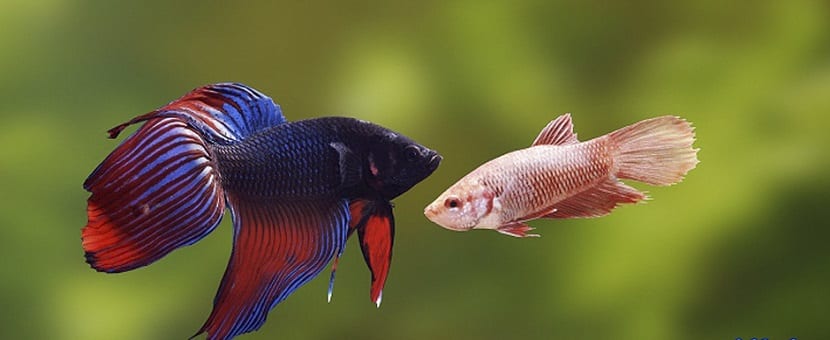
Distinguishing between a male and female betta is usually quite simple, especially in the long-finned varieties. Male bettas typically have a longer, more robust body , with much larger and more spectacular fins . Their colors tend to be more intense and vibrant, particularly when they are displaying or feel threatened.
The female, on the other hand, usually has a somewhat more compact and shorter body , with smaller fins and a more understated appearance. Although they can also be very colorful, their coloration is usually more uniform and less exaggerated than that of the males. In many adult females, a small white spot can be observed on the ventral area, near the base of the pelvic fins; this is the so-called "spawning site" or ovipositor, through which they release their eggs.
Another very marked difference is behavior. The male is generally much more aggressive and territorial than the female, and does not usually tolerate the presence of another male in the same aquarium. Females, on the other hand, can live together in small groups (called "sororities") of about 4 or 5 females, provided they have enough space and plenty of hiding places to reduce stress and establish hierarchies without serious harm.
Regarding lifespan, with good care both males and females can live between three and five years or more . However, in small containers without proper maintenance, their lifespan is often considerably shortened. Therefore, regardless of sex, it is preferable to provide aquariums with sufficient volume, heating, and good water quality.
Males prefer to swim in calm waters with gentle filtration , avoiding strong currents that hinder their swimming and damage their fins. Females, being more active and having shorter fins, generally tolerate filters with slightly higher flow better, within reasonable limits.
How to care for a betta fish
Betta fish are generally hardy and easy to care for if you understand their basic needs. Simply changing the water occasionally and feeding them isn't enough; it's important to provide them with a stable, enriched environment with appropriate water parameters.
With proper care, many bettas in home aquariums live for more than three years and even longer, maintaining vibrant colors and active behavior. The most important aspects of their habitat and maintenance routine are detailed below.
Habitat and water parameters
Many people who keep betta fish know they can live in shallow water and therefore keep them in very small containers (bowls, vases, etc.). Although bettas can survive in these small containers, they are not the optimal conditions for them to thrive. The ideal environment is an aquarium with warm water, sufficient space, and good stability.
Temperature is a key factor: if the water temperature consistently drops below about 22°C, the fish will weaken and become more susceptible to disease. A temperature of around 26°C is usually very comfortable for most bettas, provided it remains stable. The recommended pH is neutral or slightly acidic, around 6,5–7,0 for most home aquarium setups.
Therefore, it is highly recommended to have an aquarium heater suitable for the volume of the tank and a water quality meter (thermometer, pH test, ammonia, nitrites, nitrates) to ensure at all times that the conditions are safe for the fish.
Habitat dimensions and compatibility
Although bettas are aggressive towards each other, this doesn't mean they have to live in isolation. It is true, however, that a male betta is much happier when he is the only betta in the tank . Males tend to fight with other bettas, whether male or female, if the space is insufficient or if they are not introduced properly.
Regarding aquarium size, although they can survive in 2 or 3 liter containers, a 20-liter or larger aquarium is recommended for a single betta to ensure a good quality of life. The larger the volume, the more stable the water parameters will be and the easier it will be to keep the water clean. If you plan to keep a group of females or a community aquarium with other species, you will need to increase the volume even further (for example, to 40 liters or more).
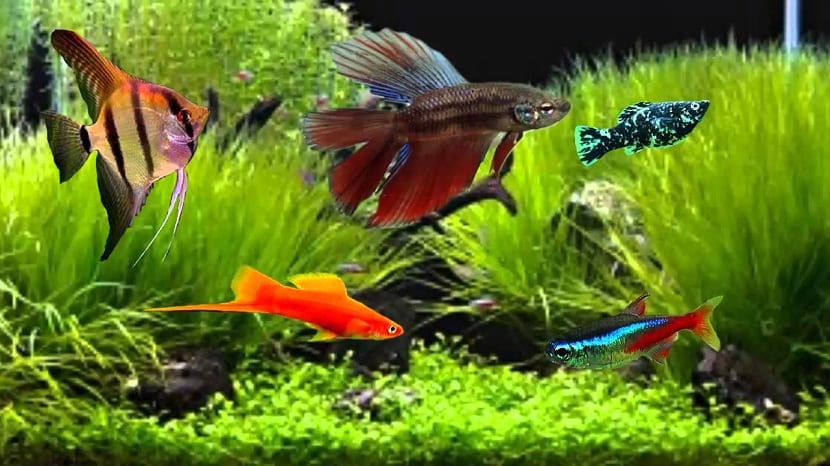
A male betta can live with peaceful, small, and inconspicuous fish , provided they are not aggressive, do not have long fins, and do not have overly bright colors that could be mistaken for another betta. Possible tank mates include some peaceful tetras, small rasboras, corydoras, caridina shrimp, or snails, always adapting the setup to the needs of all the fish.
On the other hand, it is preferable to avoid keeping the betta with:
- Other male bettas, since they will almost certainly fight.
- Fast-swimming, fin-biting species (for example, some barbs), which can damage their delicate tails.
- Very colorful fish or fish with large fins (such as certain guppies or gouramis), which may be perceived as rivals and trigger attacks.
Betta fish tank accessories

Bettas love having places to hide and explore , especially females and shyer fish. To provide this, it's a good idea to add specific hiding places , such as logs, ceramic caves, or securely placed rocks.
If you want to add plants, the ideal choice is live plants (such as anubias, Java ferns, mosses, duckweed, or similar floating plants) or, failing that, artificial plants specifically designed for bettas, with soft leaves that won't tear their fins. Hard plastic plants with sharp edges can break or fray the fins , so it's best to avoid them.
Bettas can live without an air pump, as their labyrinth organ allows them to take in oxygen from the surface. However, a gentle filtration system and moderate aeration help maintain good water quality and reduce maintenance. The important thing is that the current generated by the filter is not excessive.
It is essential that betta aquariums have some type of lid or cover , as they are excellent jumpers and, if startled or excited, can leap several centimeters above the water's surface. The tank should not be filled to the brim; leaving some free space allows the fish to breathe comfortably and reduces the risk of it jumping out.
As for the cost, betta fish typically range from €5 to €15 per fish, depending on the variety, size, and rarity of the color pattern. Fry or juveniles can be found for less, around €1 in some cases.

As you can see, although bettas have a reputation de peces fighters and aggressive, they are also Fascinating pets, easy to care for and very grateful When provided with the right environment, such as a well-sized aquarium with clean water and stable parameters, a varied diet, and decorations suited to their needs, it's possible to enjoy their distinctive colors, shapes, and behavior for years to come.